Texts: Please help me out on these problems.
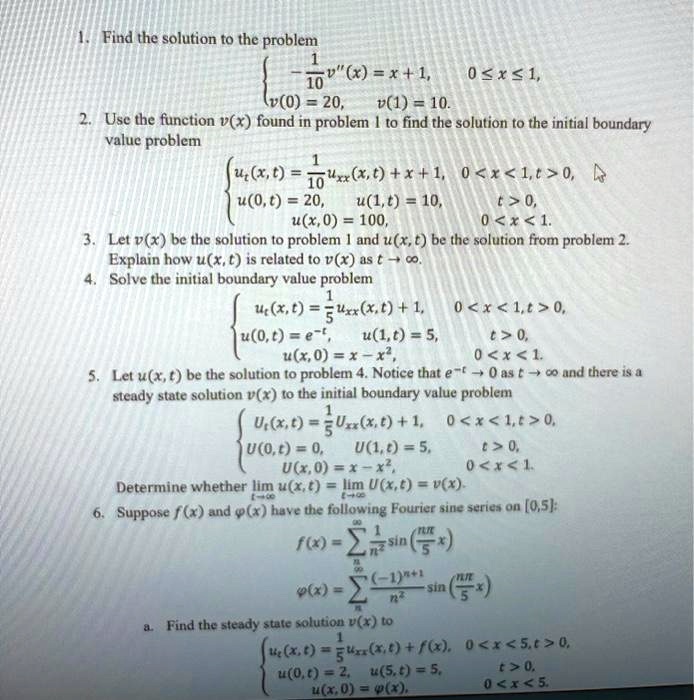
Find the solution to problem 1:
0x^2, v1=10.
v0=20,
2. Use the function v(x) found in problem I to find the solution to the initial boundary value problem 1:
u0=20, u1=10, ux0=100
t>0, 0>x>0
3. Let vx be the solution to problem I and uxt be the solution from problem 2. Explain how uxt is related to vx as t approaches infinity.
4. Solve the initial boundary value problem 1:
0<x<1, t>0, u0,t=e^-t, u1,t=5, t>0, ux,0=x
1>x>0
5. Let uxt be the solution to problem 4. Notice that e^-t approaches 0 as t approaches infinity and there is a steady state solution v(x) to the initial boundary value problem:
0<1>x>0
u0,t=0, u1=5, ux.0=x-x
t>0, t>x>0. Determine whether lim ux,t=lim U(x,t)=vx.
6. Suppose f(x) and x have the following Fourier sine series on [0,5]: f(x)=sn.
a. Find the steady state solution vx to:
u0,t=2u5,t=5, ux.0=x
t>0, s>x>0.