Ace - AI Tutor
Ask Our Educators
Textbooks
My Library
Flashcards
Scribe - AI Notes
Notes & Exams
Download App
sofia fern-ndez

sofia f.

Divider

Questions asked

BEST MATCH

Select all that apply! Glutamine synthases have multiple identical subunits; bacterial GSI has 12 identical subunits. This enzyme, as an example of cumulative feedback inhibition, is under complex regulatory control. The allosteric inhibitors of GSI include ___. CTP glycine histidine proline ATP tryptophan threonine CDP AMP lysine glutamate glucosamine 6-phosphate alanine oxaloacetate glutamine isoleucine carbamoyl phosphate alpha-ketoglutarate arginine asparagine aspartate methionine

View Answer
divider
BEST MATCH

A boat is pulled into a dock by means of a rope attached to a pulley on the dock. The rope is attached to the front of the boat, which is 8 feet below the level of the pulley. If the rope is pulled through the pulley at a rate of 20 ft/min, at what rate will the boat be approaching the dock when 110 ft of rope is out? The boat will be approaching the dock at ft/min. Hint: Sketch a diagram of this situation.

View Answer
divider
BEST MATCH

Thomas Malthus' "An Essay on the Principle of Population" FAILED to recognize: That population growth will eventually lead to starvation and death due to the lack of food production capacity The trend in decreasing population The ability of society to respond to population growth using technology and innovation That food production capacity will grow at the same rate as population

View Answer
divider
BEST MATCH

Separation is a tool used to compartmentalize processes and increase the security of concurrently running applications Question 33 options: True False

View Answer
divider
BEST MATCH

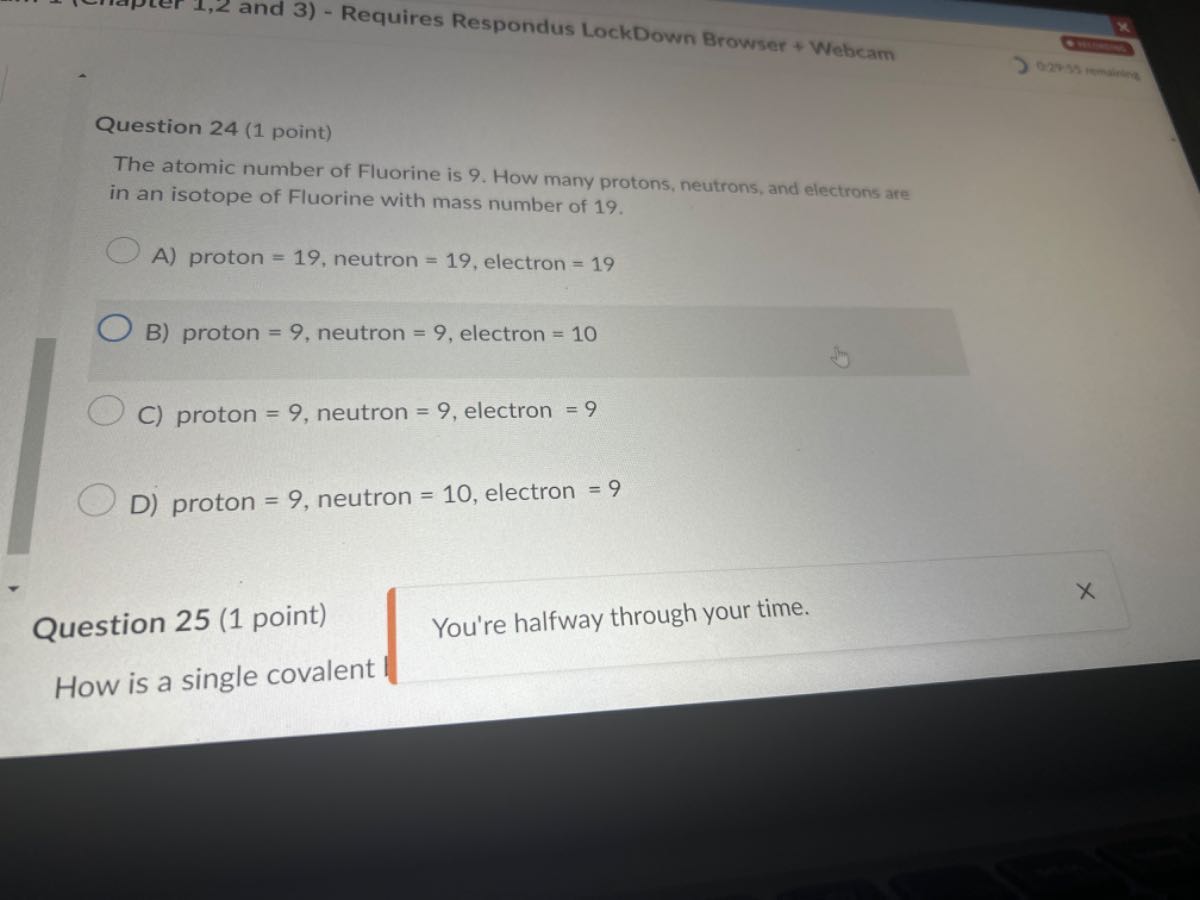
Question 24 (1 point) The atomic number of Fluorine is 9 . How many protons, neutrons, and electrons are in an isotope of Fluorine with mass number of 19. A) proton \( =19 \), neutron \( =19 \), electron \( =19 \) B) proton \( =9 \), neutron \( =9 \), electron \( =10 \) C) proton \( =9 \), neutron \( =9 \), electron \( =9 \) D) proton \( =9 \), neutron \( =10 \), electron \( =9 \) Question 25 (1 point) How is a single covalent I You're halfway through your time.
View Answer
divider
BEST MATCH

If you better remember the words "happy" and "cheerful" from a list of words because they are characteristics you embody, you are likely experiencing: Question 7 options: A) levels of processing. B) mood-dependent memory. C) the encoding specificity principle. D) the self-reference effect.

View Answer
divider
BEST MATCH

Construction of the Canadian Pacific Railway in the 1800's increased Question 27 options: the quantity of land. human capital. the quality of entrepreneurship. the quantity of entrepreneurship. the quantity of labour.

View Answer
divider
BEST MATCH

(1 point) Determine the limit. lim_(x->1)(3-x)/((x-1)^(2)) Limit = help (limits) 1 point Determine the limit. 3- Limit= help(limits)

View Answer
divider
BEST MATCH

Independent random samples from approximately normal populations produced the results shown below. Assume that the population variances are equal. Do the data present sufficient evidence to conclude that µ1-µ2 ? 16, use the rejection region approach? Use ?=0.01. Find a 99% confidence interval and interpret your results. Sample 1 Sample 2 47 68 27 51 31 58 30 55 45 50 45 30 26 37 36 37 58 48 55 70

View Answer
divider
BEST MATCH

1.) a. Let C0 = [0, 1]. To construct Cn, remove 2^(n−1) intervals of length 1/4^n from Cn−1. Write C1, C2, and (if you’re patient and love fractions) C3. b. What is the total length of the intervals that you have removed? What should the “length” of this new Cantor set be? c. Does this new Cantor set contain any intervals? Is it closed? Prove your claims.

View Answer
divider