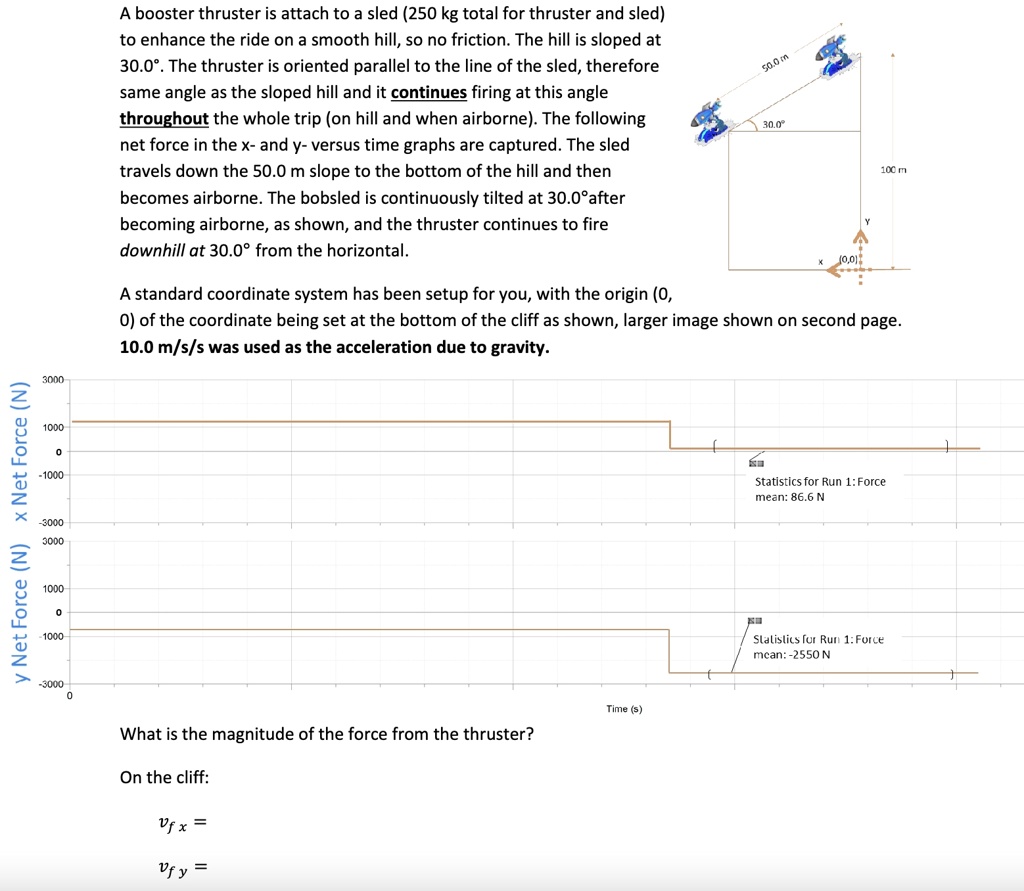
A booster thruster is attach to a sled (250 kg total for thruster and sled)
to enhance the ride on a smooth hill, so no friction. The hill is sloped at
30.0°. The thruster is oriented parallel to the line of the sled, therefore
same angle as the sloped hill and it continues firing at this angle
throughout the whole trip (on hill and when airborne). The following
net force in the x- and y- versus time graphs are captured. The sled
travels down the 50.0 m slope to the bottom of the hill and then
becomes airborne. The bobsled is continuously tilted at 30.0°after
becoming airborne, as shown, and the thruster continues to fire
downhill at 30.0° from the horizontal.
A standard coordinate system has been setup for you, with the origin (0,
0) of the coordinate being set at the bottom of the cliff as shown, larger image shown on second page.
10.0 m/s/s was used as the acceleration due to gravity.
What is the magnitude of the force from the thruster?
On the cliff:
$v_f$ x =
$v_f$ y =