Remaining "How Did I Do?" Uses: 4/5
The midpoint rule does not compute an integral $\int_a^b f(x) \, dx$ exactly. The error is the difference between the midpoint rule estimate $M_n$ and the actual
value; we cannot find the actual error unless we can evaluate the integral exactly. We have a formula for an error bound on the midpoint rule, depending on
f, a, b and n; we can calculate the error bound without evaluating the integral exactly. The important theorem is that the error on the estimate will always be
less than or equal to the error bound, in absolute value.
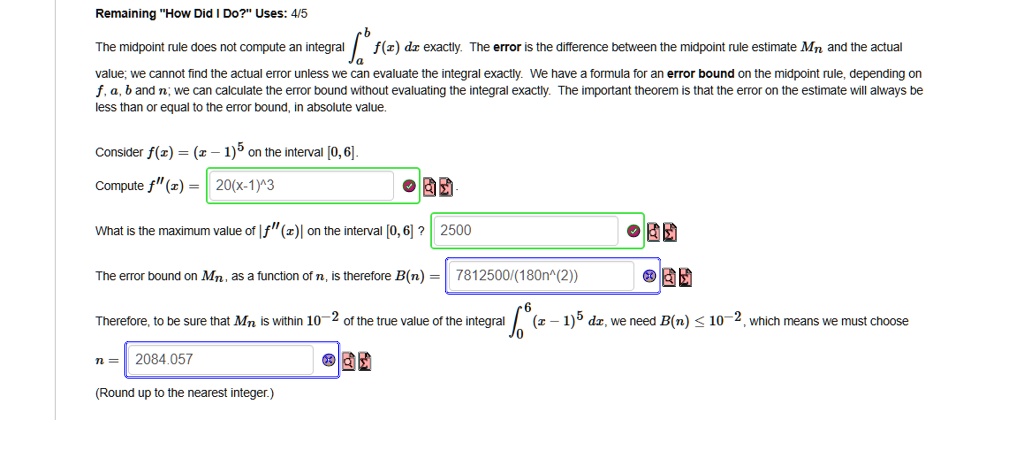
Consider $f(x) = (x - 1)^5$ on the interval $[0, 6]$.
Compute $f''(x) = 20(x - 1)^3$
What is the maximum value of $|f''(x)|$ on the interval $[0, 6]$? 2500
The error bound on $M_n$, as a function of n, is therefore $B(n) = \frac{7812500}{180n^2}$
Therefore, to be sure that $M_n$ is within $10^{-2}$ of the true value of the integral $\int_0^6 (x - 1)^5 \, dx$, we need $B(n) \le 10^{-2}$, which means we must choose
n = 2084.057
(Round up to the nearest integer.)