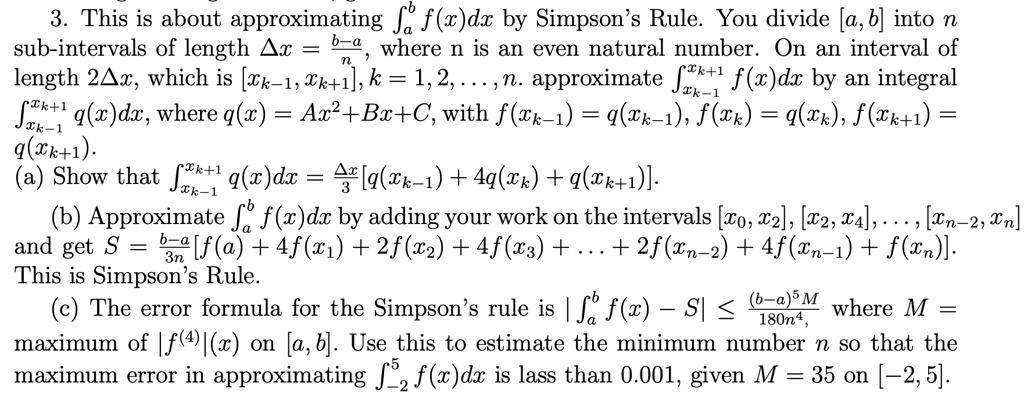
3. This is about approximating $\int_a^b f(x)dx$ by Simpson's Rule. You divide $[a, b]$ into $n$ sub-intervals of length $\Delta x = \frac{b-a}{n}$, where $n$ is an even natural number. On an interval of length $2\Delta x$, which is $[x_{k-1}, x_{k+1}]$, $k = 1, 2, \dots, n$, approximate $\int_{x_{k-1}}^{x_{k+1}} f(x)dx$ by an integral $\int_{x_{k-1}}^{x_{k+1}} q(x)dx$, where $q(x) = Ax^2 + Bx + C$, with $f(x_{k-1}) = q(x_{k-1})$, $f(x_k) = q(x_k)$, $f(x_{k+1}) = q(x_{k+1})$.
(a) Show that $\int_{x_{k-1}}^{x_{k+1}} q(x)dx = \frac{\Delta x}{3}[q(x_{k-1}) + 4q(x_k) + q(x_{k+1})]$.
(b) Approximate $\int_a^b f(x)dx$ by adding your work on the intervals $[x_0, x_2]$, $[x_2, x_4]$, $\dots$, $[x_{n-2}, x_n]$ and get $S = \frac{b-a}{3n}[f(a) + 4f(x_1) + 2f(x_2) + 4f(x_3) + \dots + 2f(x_{n-2}) + 4f(x_{n-1}) + f(x_n)]$. This is Simpson's Rule.
(c) The error formula for the Simpson's rule is $|\int_a^b f(x) - S| \le \frac{(b-a)^5}{180n^4}M$, where $M = $ maximum of $|f^{(4)}(x)|$ on $[a, b]$. Use this to estimate the minimum number $n$ so that the maximum error in approximating $\int_{-2}^5 f(x)dx$ is less than 0.001, given $M = 35$ on $[-2, 5]$.