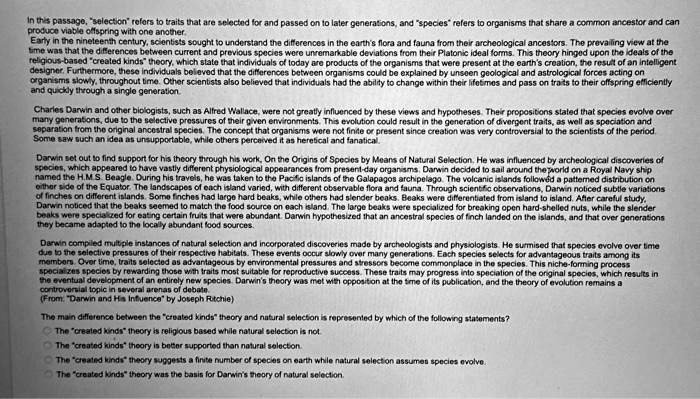
Texts: In this passage, selection refers to traits that are selected for and passed on to later generations. It refers to organisms that share a common ancestor and can produce viable offspring with one another. Early in the nineteenth century, scientists sought to understand the differences in the earth's flora and fauna from their archaeological ancestor. The prevailing view at the time was that the differences between organisms could be explained by unsensed geological and astrological forces acting on and quickly through a single generation. Charles Darwin and other biologists, such as Alfred Wallace, were not greatly influenced by these ideas and hypotheses. The propositions stated that species evolve over time through separation from the original ancestral species. The concept that organisms were not finite or present since creation was very controversial to the scientists of the period. Some saw such an idea as unsupported, while others perceived it as heretical and fanatical. Darwin set out to find support for his theory through his work, "On the Origin of Species by Means of Natural Selection." He was influenced by archaeological discoveries of species, which appeared to have vastly different physiological appearances from present-day organisms. Darwin decided to sail around the world on a Royal Navy ship named the H.M.S. Beagle. During his travel, he was taken to the Pacific islands of the Galapagos archipelago. The volcanic islands followed a patterned distribution of finches on different islands. Some finches had large hard beaks, while others had slender beaks. Beaks were differentiated from island to island. After careful study, Darwin noticed that the beaks seemed to match the food source on each island. The large beaks were specialized for breaking open hard-shelled nuts, while the slender beaks became adapted to the locally abundant food sources. Darwin compiled multiple instances of natural selection and incorporated discoveries made by archaeologists and physiologists. He surmised that species evolve over time through natural selection, rewarding those with traits most suitable for reproductive success. These traits may progress into speciation of the original species, which results in a controversial topic in several arenas of debate.
The main difference between the created Kinds theory and natural selection is represented by which of the following statements?
A. The created Kinds theory is religious-based while natural selection is not.
B. The created Kinds theory is better supported than natural selection.
C. The created Kinds theory suggests a finite number of species on earth while natural selection assumes species evolve.
D. The created Kinds theory was the basis for Darwin's theory of natural selection.