Ace - AI Tutor
Ask Our Educators
Textbooks
My Library
Flashcards
Scribe - AI Notes
Notes & Exams
Download App
sonya ramirez

sonya r.

Divider

Questions asked

BEST MATCH

Jared, age 49, earns $300,000 per year and is a participant in his employer's 401(k) plan. Ignoring the ADP T requirements, what is the maximum amount that Jared can defer under the 401(k) plan during 20257 A. $23,500 B. $31,000 C. $70,000 D. $77,000

View Answer
divider
BEST MATCH

1) Maricia purchased a leather bag online from the United States. The bag cost $ 135 USD, it was subject to an 11% duty and Maricia had to pay 13% HST. If the exchange rate was US$1 = C$1.39, what was the total cost of the bag in Canadian dollars?

View Answer
divider
BEST MATCH

What is a key advantage of packet switching over circuit switching for real-time services?

View Answer
divider
BEST MATCH

16) Charcot's research delved into the connection between psychology and which aspect of health behavior change? a) Exercise adherence b) Smoking cessation c) Healthy eating habits d) Stress management

View Answer
divider
BEST MATCH

Which of the following shows $(2x+y)^4$ in expanded notation? Select one: A. $16x^4 + y^4$ B. $2x^4 + 8x^3y + 12x^2y^2 + 8xy^3 + y^4$ C. $16x^4 + 8x^3y + 4x^2y^2 + 2xy^3 + y^4$ D. $16x^4 + 32x^3y + 24x^2y^2 + 8xy^3 + y^4$

View Answer
divider
BEST MATCH

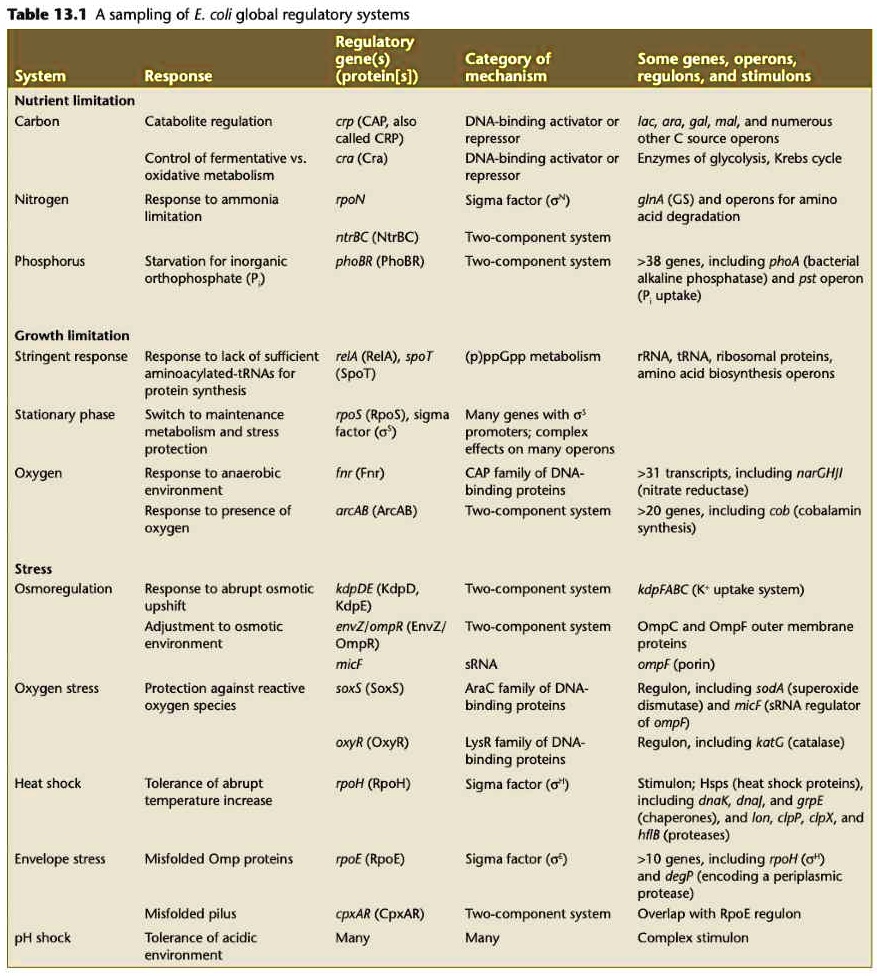
Use “Table 13.1 A sampling of E. coli global regulatory systems” to answer the following questions about global regulation. List 11 examples of conditions for which the cell has global regulatory mechanisms? (ex. Carbon limitation) You do not need to describe, just list. List 3 mechanisms BESIDES two-component regulatory systems and Sigma factors for global regulation. Table 13.1 A sampling of E. coli global regulatory systems Regulatory System Response (protein[s]) Nutrient limitation Carbon Catabolite regulation crp(CAP also Called CRP) Control of fermentative vs cra(Cra) oxidative.metabolism Nitrogen Response to ammonia rpoN limitation ntrBC(NtrBC) Phosphorus Starvation for inorganic phoBR(PhoBR) orthophosphate(P) Category of mechanism Some genes, operons regulons, and stimulons DNA-binding activator or lacara, gal, mal, and numerous repressor other C source operons DNA-binding activator or Enzymes of glycolysis, Krebs cycle repressor Sigma factor( glnA (GS) and operons for amino acid degradation Two-component system Two-component system >38 genes, including phoA (bacterial alkaline phosphatase) and pst operon P uptake) Growth limitation Stringent response Response to lack of sufficient relA RelA spoT (p)ppGpp metabolism aminoacylated-tRNAs for (SpoT) protein synthesis Stationary phase Switch to maintenance rpoS RpoS, sigma Many genes with g metabolism and stress factor(as) promoters; complex protection effects on many operons Oxygen Response to anaerobic fnr(Fnr) CAP family of DNA- environment binding proteins Response to presence of arcAB(ArcAB Two-component system oxygen rRNA, tRNA, ribosomal proteins, amino acid biosynthesis operons >31 transcripts, including narCHj (nitrate reductase) >20 genes, including cob (cobalamin Stress Osmoregulation Response to abrupt osmotic upshift Adjustment to osmotic environment kdpDE(KdpD, Two-component system KapE) envZ/ompR(EnvZ/ Two-component system OmpR) micF sRNA 5oxS (SoxS) AraC family of DNA- binding proteins kdpFABC(K uptake system) OmpC and OmpF outer membrane proteins ompF(porin Regulon including sodA(superoxide dismutase and micF(sRNA regulator of ompF Regulon including katG catalase Oxygen stress Protection against reactive oxygen species oxyR(OxyR) LysR family of DNA- binding proteins Sigma factor (a Heat shock Tolerance of abrupt temperature increase rpoH(RpoH) Stimulon; Hsps (heat shock proteins), including dnaKdna land grpE chaperones, and loncpP, clpxand hflB(proteases) >10 genes, including rpoH and degP encoding a periplasmic protease) Overlap with RpoE regulon Complex stimulon Envelope stress Misfolded Omp proteins rpoE(RpoE) Sigma factor(o Misfolded pilus Tolerance of acidic environment cpxAR(CpxAR) Many Two-component system Many pH shock
View Answer
divider
BEST MATCH

We will solve the system $\vec{x}\prime = \begin{bmatrix} 1 & -1 \ 2 & 3 \end{bmatrix} \vec{x}$. First, find the eigenvalues $\lambda$ of $\begin{bmatrix} 1 & -1 \ 2 & 3 \end{bmatrix}$ and write them separated by commas: 2+i, 2-i Note that the $\lambda$ are in the form $a + ib$ and $a - ib$. For the eigenvalue $a + ib$, find an eigenvector $\vec{v}$ in the form $\begin{bmatrix} c \ 2 \end{bmatrix}$: $\begin{bmatrix} -1+i \ 2 \end{bmatrix}$ Compute the real part $\text{Re } \vec{v}e^{(a+ib)t}$: Compute the imaginary part $\text{Im } \vec{v}e^{(a+ib)t}$: Construct the general solution: (Use $c_1$ and $c_2$ for $C_1$ and $C_2$.)

View Answer
divider
BEST MATCH

Determine the power supplied by each of the independent sources in the circuit shown in Figure

View Answer
divider
BEST MATCH

A high-voltage transmission line with a resistance of 0.34 ?/km carries a current of 1025 A. The line is at a potential of 650 kV at the power station and carries the current to a city located 156 km from the station. (a) What is the power loss due to resistance in the line? MW (b) What fraction of the transmitted power does this loss represent? %

View Answer
divider
BEST MATCH

7. What is the future value of a 3-year loan of $1000 at 5% interest? Show your work. (3 points) 8. What is the present value of $1000 received in three years if the interest rate is 5%? Show your work. (3 points)

View Answer
divider