Ace - AI Tutor
Ask Our Educators
Textbooks
My Library
Flashcards
Scribe - AI Notes
Notes & Exams
Download App
sophia lee

sophia l.

Divider

Questions asked

BEST MATCH

Which tax accounting method allows businesses to record income and expenses as they occur, regardless of when cash is received or paid? Group of answer choices Accrual method Installment method Cash method Hybrid method

View Answer
divider
BEST MATCH

Find the limit. Use l'Hospital's Rule where appropriate. If there is a more elementary method, consider using it. lim x→5 x − 5/(x^2 − 25)

View Answer
divider
BEST MATCH

Which statement(s) is/are true regarding the absolute refractory period? all of these are true Describes the period of time when a strong stimulus can initiate a second action potential Prevents an action potential from starting another action potential at the same point on the plasma membrane at the same time Begins when the membrane voltage hyperpolarizes

View Answer
divider
BEST MATCH

If a stock has a beta of 2 market return of 8 percent and risk free rate is 2 percent according to capm

View Answer
divider
BEST MATCH

Question 6 (0.13 points) All of the following are true about "I" statements EXCEPT that _____ when we say "I," we are focusing on our feelings, beliefs, and interpretations when we use "I," we are avoiding directed criticism when we say "I," the other person may feel less defensive when we use "I," the other person is less likely to listen to us

View Answer
divider
BEST MATCH

MyLab Statistics with Pearson eText -- 18 Week Standalone Access Card -- for Elementary Statistics: Picturing the World with Integrated Review

View Answer
divider
BEST MATCH

STUDIES HAVE SHOWN THAT AN EMERGENCY VEHICLE TRAVELING FASTER THAN _____ MPH CAN POSSIBLY OUTRUN THE EFFECTIVE RANGE OF ITS AUDIBLE WARNING DEVICES A) 25B) 45C) 50D) 40

View Answer
divider
BEST MATCH

1. For a three-phase completely transposed 70 km line, the maximum permissible voltage regulation of the line is given 5%. The voltage at the end of the line is 370 kV under the full load and 380 kV under the no load. The line impedance per phase is 0.02 + 0.3j ohm/km, and line admittance per phase is j0.00006 S/km. By using the two-port network representation, parameter B is found as parameter D is found as source voltage and the voltage at the beginning of the line is found as 320 kV under the given loading. Is there any voltage regulation problem on the line? Explain your answer. There is a voltage regulation problem in the line impedance and line admittance per phase

View Answer
divider
BEST MATCH

The figure below shows the standard setup for Young's double-slit experiment. The spacing between the slits is $d$, and the screen is a distance $L$ away from the slits. The derivation of the two-slit interference conditions assumes that the two lines of sight to a point P are parallel, since $L \gg d$, allowing us to approximate the path length difference as $\Delta l = d \sin \theta$. How good is this approximation? Suppose that $L = 2.00 \text{ cm}$, $d = 0.720 \text{ mm}$, and $\theta = 11.00^\circ$. (Under normal experimental conditions, $L/d$ would be much larger than this, but we want to test the approximation for a case where $L$ is closer to $d$.) Use geometry and trigonometry to compute the value for the actual path length difference $\Delta l$. Enter your answer as a positive value. By what percentage does this value differ from the approximation $\Delta l = d \sin \theta$? (Enter your answer as a positive number, without the percent sign. Be sure to keep lots of digits in your calculations!)

View Answer
divider
BEST MATCH

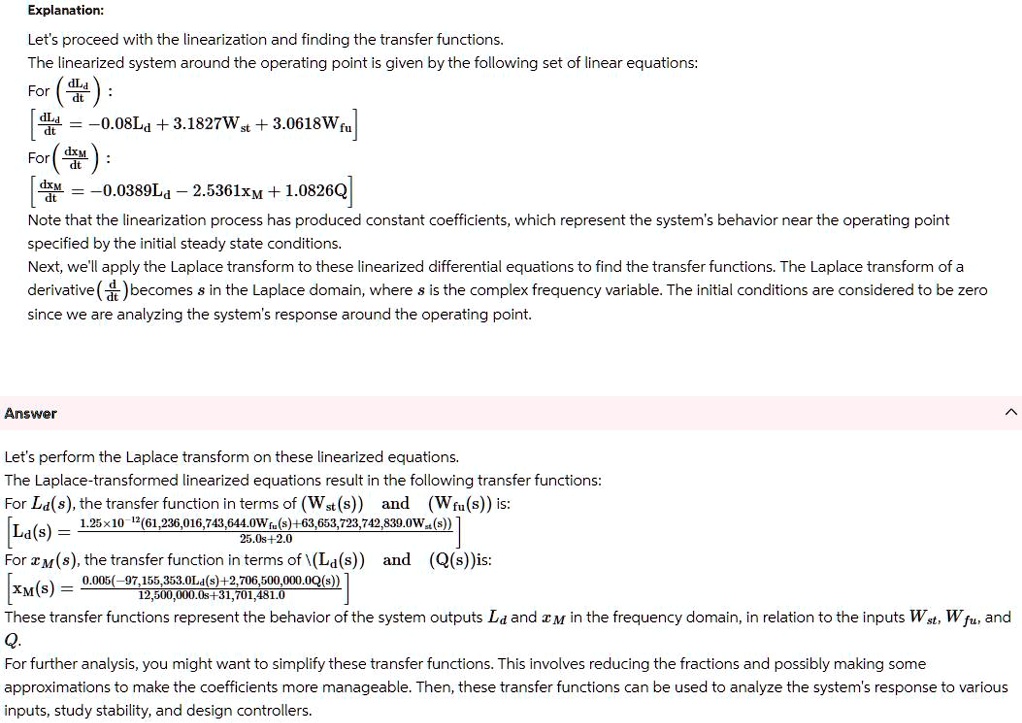
Here I also want to know the step-by-step that you used to find the transfer function and why are the parameters of the transfer function very large? Also, help me to find the transfer function that enables me to design the controller for this linearized system. Explanation: Let's proceed with the linearization and finding the transfer functions. The linearized system around the operating point is given by the following set of linear equations: -0.08La + 3.1827Wst + 3.0618Wfu = -0.0389L - 2.5361xM + 1.0826Q. Note that the linearization process has produced constant coefficients, which represent the system's behavior near the operating point specified by the initial steady state conditions. Next, we'll apply the Laplace transform to these linearized differential equations to find the transfer functions. The Laplace transform of a derivative (d/dt) becomes s in the Laplace domain, where s is the complex frequency variable. The initial conditions are considered to be zero since we are analyzing the system's response around the operating point. Answer: Let's perform the Laplace transform on these linearized equations. The Laplace-transformed linearized equations result in the following transfer functions: For Las, the transfer function in terms of Wst and Wfu is: 25.0s^2. For Ms, the transfer function in terms of Las and Q is: 12,500,000.0s + 31,701,481. These transfer functions represent the behavior of the system outputs Ia and in the frequency domain, in relation to the inputs Wst, Wfu, and Q. For further analysis, you might want to simplify these transfer functions. This involves reducing the fractions and possibly making some approximations to make the coefficients more manageable. Then, these transfer functions can be used to analyze the system's response to various inputs, study stability, and design controllers.
View Answer
divider