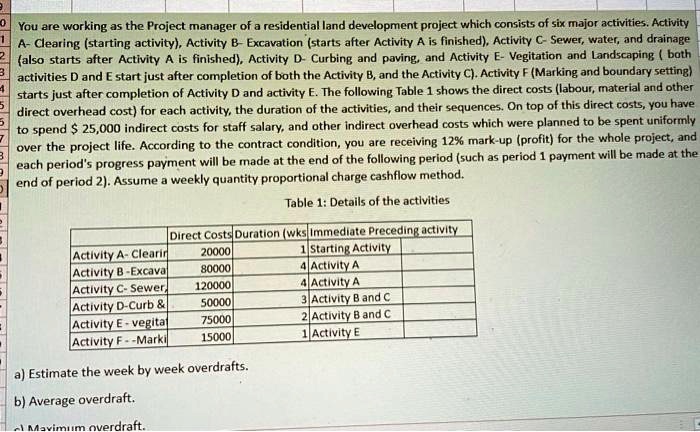
You are working as the Project manager of a residential land development project which consists of six major activities. Activity
A- Clearing (starting activity), Activity B- Excavation (starts after Activity A is finished), Activity C- Sewer, water, and drainage
(also starts after Activity A is finished), Activity D- Curbing and paving, and Activity E- Vegitation and Landscaping (both
activities D and E start just after completion of both the Activity B, and the Activity C). Activity F (Marking and boundary setting)
starts just after completion of Activity D and activity E. The following Table 1 shows the direct costs (labour, material and other
direct overhead cost) for each activity, the duration of the activities, and their sequences. On top of this direct costs, you have
to spend $ 25,000 indirect costs for staff salary, and other indirect overhead costs which were planned to be spent uniformly
over the project life. According to the contract condition, you are receiving 12% mark-up (profit) for the whole project, and
each period's progress payment will be made at the end of the following period (such as period 1 payment will be made at the
end of period 2). Assume a weekly quantity proportional charge cashflow method.
Table 1: Details of the activities
Direct Costs Duration (wks Immediate Preceding activity
Activity A- Clearin 20000 1 Starting Activity
Activity B- Excava 80000 4 Activity A
Activity C- Sewer, 120000 4 Activity A
Activity D- Curb & 50000 3 Activity B and C
Activity E- vegita 75000 2 Activity B and C
Activity F- Marki 15000 1 Activity E
a) Estimate the week by week overdrafts.
b) Average overdraft.
Maximum overdraft.