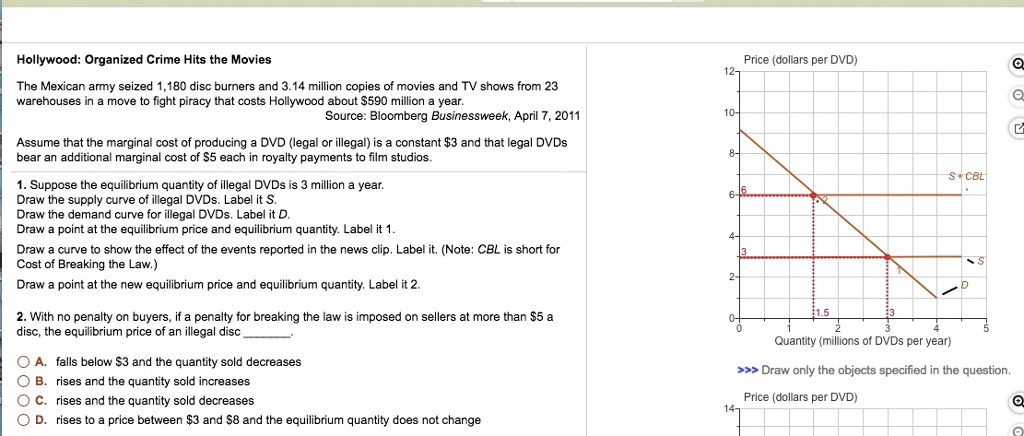
With respect to the graph and overall question, I am looking for the answer to question #2: With no penalty on buyers, if a penalty for breaking the laws is imposed on sellers at more than $5 per disc, what is the equilibrium price of an illegal disc?
Hollywood: Organized Crime Hits the Movies
Price (dollars per DVD): 12
The Mexican army seized 1,180 disc burners and 3.14 million copies of movies and TV shows from 23 warehouses in a move to fight piracy that costs Hollywood about $590 million a year. Source: Bloomberg Businessweek, April 7, 2011
Price (dollars per DVD): 10
C
Assume that the marginal cost of producing a DVD (legal or illegal) is a constant $3 and that legal DVDs bear an additional marginal cost of $5 each in royalty payments to film studios.
1. Suppose the equilibrium quantity of illegal DVDs is 3 million per year. Draw the supply curve of illegal DVDs and label it S. Draw the demand curve for illegal DVDs and label it D. Draw a point at the equilibrium price and equilibrium quantity and label it 1. Draw a curve to show the effect of the events reported in the news clip and label it. (Note: CBL is short for Cost of Breaking the Law.) Draw a point at the new equilibrium price and equilibrium quantity and label it 2.
S * CBL
2. With no penalty on buyers, if a penalty for breaking the law is imposed on sellers at more than $5 per disc, what is the equilibrium price of an illegal disc?
Quantity (millions of DVDs per year)
O A. falls below $3 and the quantity sold decreases
O B. rises and the quantity sold increases
O C. rises and the quantity sold decreases
O D. rises to a price between $3 and $8 and the equilibrium quantity does not change
Draw only the objects specified in the question.
Price (dollars per DVD): -