Ace - AI Tutor
Ask Our Educators
Textbooks
My Library
Flashcards
Scribe - AI Notes
Notes & Exams
Download App
stacy briones

stacy b.

Divider

Questions asked

BEST MATCH

fter reviewing the video on Apple. What do you think is the culture at Apple and how is that culture related to any of the: Primary dependent variables in OB: Select two PDVs and then offer 300 to 500 words, diving deep and wide into your responses. Productivity Absenteeism Turnover Organizational citizenship Job satisfaction

View Answer
divider
BEST MATCH

which part of the brain houses memory and abstract mental function?

View Answer
divider
BEST MATCH

During puberty, the increased production of hormones in males causes the rapid enlargement of which of the following structures of the respiratory system? 1. larynx 2. pharynx 3. esophagu 4. bronchi

View Answer
divider
BEST MATCH

Question 102 (1 point) A leftward moving object is coasting to a stop along a straight, level surface. The net force acting upon the object MUST be ____. 1) directed rightward 2) zero 3) directed leftward 4)... impossible to answer without further information.

View Answer
divider
BEST MATCH

do Quasi-experimental designs which include switching replication have lower internal validity?

View Answer
divider
BEST MATCH

While they all involve hard (and productive!) work, which of the following would not be counted in GDP? x Choose one or more: A. caring for your own children at home B. working from home as an IT consultant C. helping your kids connect to their online classes D. cooking meals at home

View Answer
divider
BEST MATCH

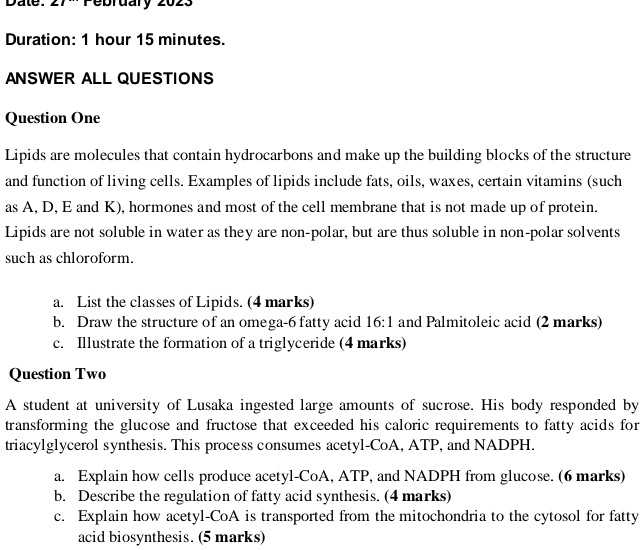
Duration: 1 hour 15 minutes. ANSWER ALL QUESTIONS Question One Lipids are molecules that contain hydrocarbons and make up the building blocks of the structure and function of living cells. Examples of lipids include fats, oils, waxes, certain vitamins (such as A, D, E and K), hormones and most of the cell membrane that is not made up of protein. Lipids are not soluble in water as they are non-polar, but are thus soluble in non-polar solvents such as chloroform. a. List the classes of Lipids. (4 marks) b. Draw the structure of an omega-6 fatty acid 16:1 and Palmitoleic acid (2 marks) c. Illustrate the formation of a triglyceride (4 marks) Question Two A student at university of Lusaka ingested large amounts of sucrose. His body responded by transforming the glucose and fructose that exceeded his caloric requirements to fatty acids for triacylglycerol synthesis. This process consumes acetyl-CoA, ATP, and NADPH. a. Explain how cells produce acetyl-CoA, ATP, and NADPH from glucose. (6 marks) b. Describe the regulation of fatty acid synthesis. (4 marks) c. Explain how acetyl-CoA is transported from the mitochondria to the cytosol for fatty acid biosynthesis. (5 marks)
View Answer
divider
BEST MATCH

Texts: Multiple Scenarios Analysis In Exhibit 9.4 on page 188 of the textbook, the authors provide the "Recommended Asset Allocation from 1985" - Reserves, Bonds, Stocks, Real Estate, Oil and Gas Partnerships, Venture Capitals, Precious Metals, and Foreign Securities. For this activity, please research the eight major classes listed in the exhibit. After your research, please analyze and report on the following: 1. How have the eight classes fared over the years? 2. What changes would you make to the eight major classes? 3. Based on your research, create your own recommended asset allocation classes list and explain why you have chosen each class.

View Answer
divider
BEST MATCH

A 30-year lease pays 150 per quarter for the first ten years and 300 per quarter for the last 20 years. The first payment will be made in six months. The annual nominal interest rate compounded quarterly is 16%. Calculate the present value of this income today. a) 4,292 b) 4,476 c) 4,647 d) 4,895 e) 5,023

View Answer
divider
BEST MATCH

Question 10 (1 point) Consider H0: $\mu$ = 30 versus H1: $\mu$ \(\neq\) 30. A random sample of 36 observations taken from this population produced a sample mean of 26.27. The population is normally distributed with $\sigma$ = 10. (a) Calculate the p-value. Round the answer to four decimal places. (b) Considering the p-value of part (a), would you reject the null hypothesis if the test were made at the significance level of 0.05? (c) Considering the p-value of part (a), would you reject the null hypothesis if the test were made at the significance level of 0.01?

View Answer
divider