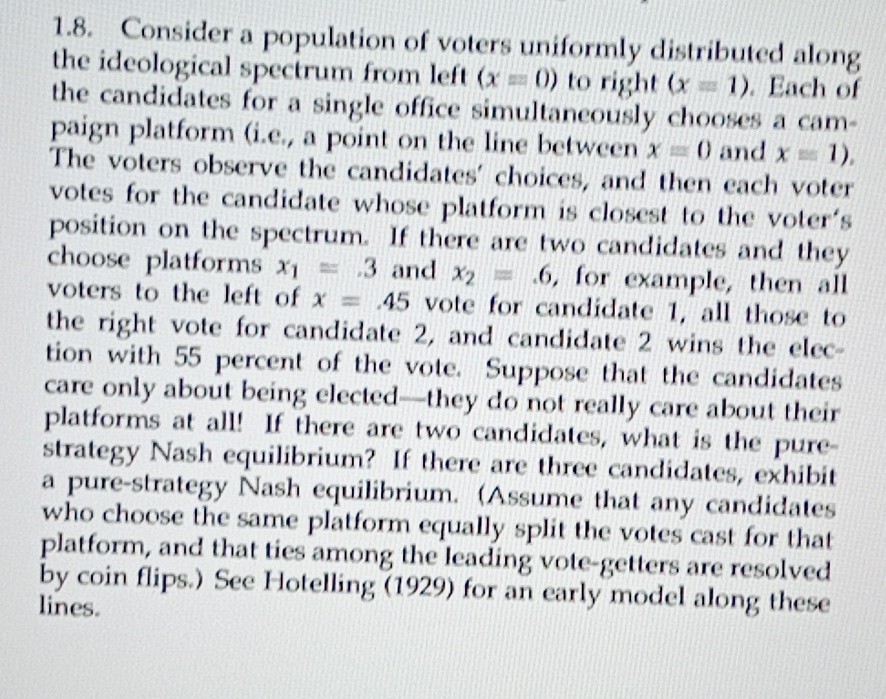
1.8. Consider a population of voters uniformly distributed along the ideological spectrum from left \( (x=0) \) to right \( (x=1) \). Each of the candidates for a single office simultaneously chooses a campaign platform (i.e, a point on the line between \( x=0 \) and \( x=1 \) ), The voters observe the candidates' choices, and then each voter votes for the candidate whose platform is closest to the voter's position on the spectrum. If there are two candidates and they choose platforms \( x_{1}=.3 \) and \( x_{2}=.6 \), for example, then all voters to the left of \( x=.45 \) vote for candidate 1 , all those to the right vote for candidate 2 , and candidate 2 wins the election with 55 percent of the vote. Suppose that the candidates care only about being elected-they do not really care about their platforms at all! If there are two candidates, what is the purestrategy Nash equilibrium? If there are three candidates, exhibit a pure-strategy Nash equilibrium. (Assume that any candidates who choose the same platform equally split the votes cast for that platform, and that ties among the leading vote-getters are resolved by coin flips.) See Hotelling (1929) for an early model along these lines.