Ace - AI Tutor
Ask Our Educators
Textbooks
My Library
Flashcards
Scribe - AI Notes
Notes & Exams
Download App
stephanie case

stephanie c.

Divider

Questions asked

BEST MATCH

Convert the angle to a decimal in degrees. $$59^\circ 50'9''$$ $$59^\circ 50'9'' = \Box^\circ$$ (Do not round until the final answer. Then round to four decimal places as needed.)

View Answer
divider
BEST MATCH

Which of the following can be classified as a regressive tax? (For a regressive tax the percentage of one's income paid as tax is higher at lower incomes than at higher incomes.) Group of answer choices Sales tax. Gasoline tax. Excise tax. All of these taxes are regressive taxes.

View Answer
divider
BEST MATCH

The objective of advertising, from an economic perspective, is to shift the demand curve to the

View Answer
divider
BEST MATCH

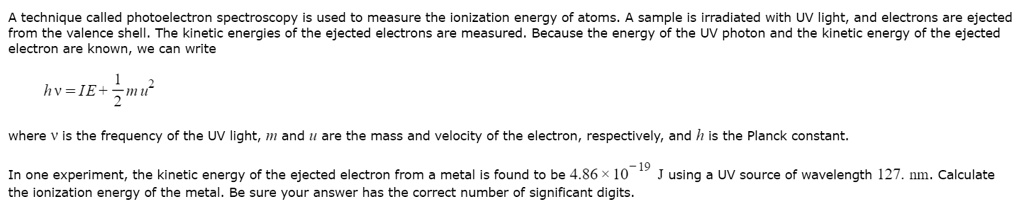
A technique called photoelectron spectroscopy is used to measure the ionization energy of atoms. A sample is irradiated with UV light, and electrons are ejected from the valence shell. The kinetic energies of the ejected electrons are measured. Because the energy of the UV photon and the kinetic energy of the ejected electron are known, we can write $hv = IE + \frac{1}{2}mu^2$ where $v$ is the frequency of the UV light, $m$ and $u$ are the mass and velocity of the electron, respectively, and $h$ is the Planck constant. In one experiment, the kinetic energy of the ejected electron from a metal is found to be $4.86 \times 10^{-19}$ J using a UV source of wavelength 127. nm. Calculate the ionization energy of the metal. Be sure your answer has the correct number of significant digits.
View Answer
divider
BEST MATCH

The functions $f$ and $g$ are defined as follows. $f(x) = \frac{x^2}{x-1}$ $g(x) = \frac{x-9}{x^2 - 12x + 27}$ For each function, find the domain. Write each answer as an interval or union of intervals. Domain of $f$: Domain of $g$:

View Answer
divider
BEST MATCH

Which of the following equations describes the parabola whose graph has its vertex at (2, 2), opens right, and contains the point \left(\frac{5}{2}, 3\right)? a) -2x + y^2 - 4y + 8 = 0 b) x^2 - 4x + 2y = 0 c) 2x + y^2 - 4y = 0 d) x^2 - 4x - 2y + 8 = 0

View Answer
divider
BEST MATCH

(45) 9. Give the major organic products for the following: \(a)\ \(CH_3CH_2OCH_2CH_3\) \(\xrightarrow{NBS \atop ROOR} \) \(b)\ \(CH_3C(CH_3)=CHCH_3\) \(\xrightarrow{HBr \atop ROOR} \) \(c)\ \(CH_3CHO\) \(\xrightarrow{NaOH} \) \(d)\ \(\text{Benzene ring with CHO} \) \(+\) \(CH_3CH_2CHO\) \(\xrightarrow{OH^-} \) \(e)\ \(CH_2(COOC_2H_5)_2 \) \(+\) \(CH_3CH_2CH_2Br\) \(\xrightarrow{-OCH_2CH_3 \atop HOCH_2CH_3} \) \(\xrightarrow{H_3O^+ \atop heat} \) \(f)\ \(CH_3CH_2CH_2OCH_2CH_3 \) \(+\) \(\text{Benzene ring with CH_2Br} \) \(\xrightarrow{-OCH_2CH_3 \atop HOCH_2CH_3} \) \(g)\ \(CH_2=CHCH_3\) \(\xrightarrow{NBS \atop ROOR} \)

View Answer
divider
BEST MATCH

(8) The Fourier transform of periodic signal \(x(t) = \sum_{n=-\infty}^{\infty} \delta(t - 2n)\) is ____. (a) \(X(j\omega) = \sum_{k=-\infty}^{\infty} \delta(\omega - k\pi)\) (b) \(X(j\omega) = 2 \sum_{k=-\infty}^{\infty} \delta(\omega - 2k)\) (c) \(X(j\omega) = \pi \sum_{k=-\infty}^{\infty} \delta(\omega - k\pi)\) (d) \(X(j\omega) = 2\pi \sum_{k=-\infty}^{\infty} \delta(\omega - 2k\pi)\) (9) An LTI system described by differential equation \(\frac{d^2y(t)}{dt^2} + 2\frac{dy(t)}{dt} + 3y(t) = \frac{dx(t)}{dt} + 2x(t)\) has a system function \(H(s) =\) ____. (a) \(\frac{2s + 1}{3s^2 + 2s + 1}\) (b) \(\frac{2s + 1}{s^2 + 2s + 3}\) (c) \(\frac{s + 2}{3s^2 + 2s + 1}\) (d) \(\frac{s + 2}{s^2 + 2s + 3}\) (10) If \(x(t)\) is absolutely integrable and its Laplace transform \(X(s) = \frac{s - 2}{(s + 3)(s - 1)}\), the ROC of \(X(s)\) must be ____. (a) \(Re\{s\} > 1\) (b) \(Re\{s\} > -3\) (c) \(-3 < Re\{s\} < 1\) (d) \(Re\{s\} < -3\)

View Answer
divider
BEST MATCH

The constraints and contracts in class and method design models were derived from the representations. Select one: a. business b. functional c. reliability d. regularly e. non-functional requirements and the problem domain

View Answer
divider
BEST MATCH

Problem 1 Consider the LTI system characterized by the input-output relationship: y(t) = \int_{-\infty}^{t} (t - \tau - 3)x(\tau)d\tau - \int_{-\infty}^{t} (t - \tau - 3)x(\tau)d\tau (a) Determine the impulse response of the system, $h_1(t)$ (b) Is the system causal? Justify your answer using the impulse response. Is the system stable? Justify your answer using the impulse response.

View Answer
divider