Ace - AI Tutor
Ask Our Educators
Textbooks
My Library
Flashcards
Scribe - AI Notes
Notes & Exams
Download App
stephanie farrell

stephanie f.

Divider

Questions asked

BEST MATCH

Define the CDS interventions that you would implement to address this area of need.

View Answer
divider
BEST MATCH

You cringe when you pass the intersection where you nearly had a car accident. Unconditioned Stimulus Unconditioned Response Conditioned Stimulus Conditioned Response

View Answer
divider
BEST MATCH

QUESTION 7 Corruption Oraises the rate of growth as bribes enhance income. Ois eliminated by foreign direct investment. Ocourtails economic growth. Oacts as a magnet for foreign direct investment.

View Answer
divider
BEST MATCH

According to James Marcia, an identity status in which the person actively explores differentpossibilities to find a truly solid adult life path

View Answer
divider
BEST MATCH

Page < 4 > of 37 ZOOM + employed, lead to very non-simple consequences. Suppose there is a park beside a straight railroad. In the park are three brothers of different ages throwing baseballs. As it happens, a commuter train is passing at the instant the three boys each throws his ball. For simplicity, we assume the balls are released simultaneously, and travel parallel to \textendash{} and in the same direction as \textendash{} the velocity of the train. The over a two- second period of time, the balls travel at constant speeds of 12.0m/s, 20.0m/s, and 32.0m/s. The train is moving at 20.0m/s. \begin{figure}[h] \centering \includegraphics[width=0.8\textwidth]{fig2} \caption{Fig. 2} \end{figure} Perhaps it is obvious that the middle ball will look like it is riding along with the train, though in reality it will look like it is falling \textendash{} the parabolic path in the park frame will turn into a straight- down path in the train frame. The 32m/s ball will appear to be going to the front of the train, though at less than 32m/s, and the ball at 12m/s will appear to be going toward the rear. Exercise 1 concerns the details. 4

View Answer
divider
BEST MATCH

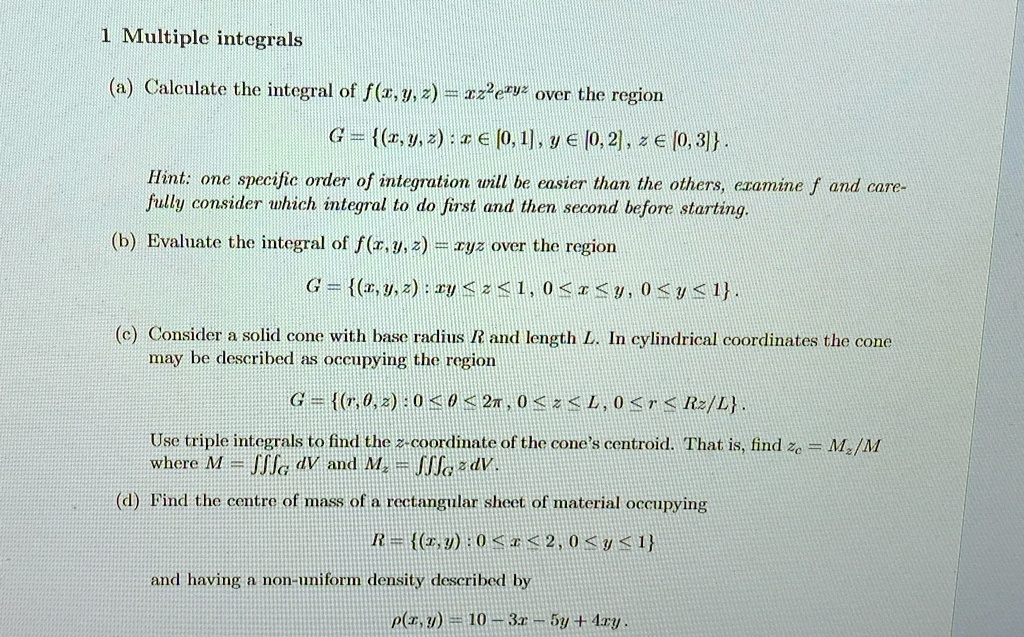
1. Multiple integrals (a) Calculate the integral of f(x,y,z) = xz^(2)e^(xyz) over the region G = {(x,y,z) : x in [0,1], y in [0,2], z in [0,3]}. Hint: one specific order of integration will be easier than the others, examine f and carefully consider which integral to do first and then second before starting. (b) Evaluate the integral of f(x,y,z) = xyz over the region RLG = {(r,θ,z) : 0 <= θ <= 2π, 0 <= z <= L, 0 <= r <= R(z)/(L)}. zz_(c) = (M_(z))/(M) M = ∭_(G)dV M_(epsi) = ∭_(G)zdV ρ(x,y) = 10 - 3x - 5y + 4xy. 2. Multiple integrals (a) Calculate the integral of fyzeyzovcr over the region G{ye0.1ye0.2ze{03} Hint: one specific order of integration uill be easier than the others, examine f and carefully consider which integral to do first and then second before starting. (b) Evaluate the integral of fryzryz over the region G{UrOVOyI} (c) Consider a solid cone with base radius R and length L. In cylindrical coordinates, the cone may be described as occupying the region G{T0OO2TOZLOTR/L} Use triple integrals to find the coordinate of the cone's centroid. That is, find ze - M/M (d) Find the center of mass of a rectangular sheet of material occupying R{020K1} and having a non-uniform density described by 10 - 3y + 4y
View Answer
divider
BEST MATCH

if $1400 grows to $2006 in 8 years what is the interest rate over that period

View Answer
divider
BEST MATCH

Question 9 of 9 Points possible: 3.00 Tries remaining: 3 The change in enthalpy for dissolving urea in water is found to be 15399 J/mol and the free energy is found to be -6861 J/mol at 20.92 °C. What is the value for the change in entropy (in units of J/(mol\cdot K)) at this temperature? Report your answer to the nearest whole number. NOTE: This example is based on a small range of actual data. Your experimental numbers may or may not fall within this range. The purpose of this question is to be an example and to give you practice in performing the calculation. Type answer:

View Answer
divider
BEST MATCH

11b). Three masses are hung from a meterstick and balanced as shown in the figure. a) Assuming the mass of the meterstick is negligible and $m_1$ = 100g and $m_2$ = 200g, what is value of $m_3$? b) If the mass of the meterstick is 150g, $m_1$ = 100g and $m_2$ = 200g, what is the value of $m_3$?

View Answer
divider
BEST MATCH

Given the following information, what is the standard enthalpy change for the reaction? $O_2(g) + 2SO_2(g) \rightarrow 2SO_3(g)$ $\Delta H_f^\circ SO_2(g) = -296.83 \text{ kJ/mol}$ $\Delta H_f^\circ O_2(g) = 0 \text{ kJ/mol}$ $\Delta H_f^\circ SO_3(g) = -395.72 \text{ kJ/mol}$

View Answer
divider