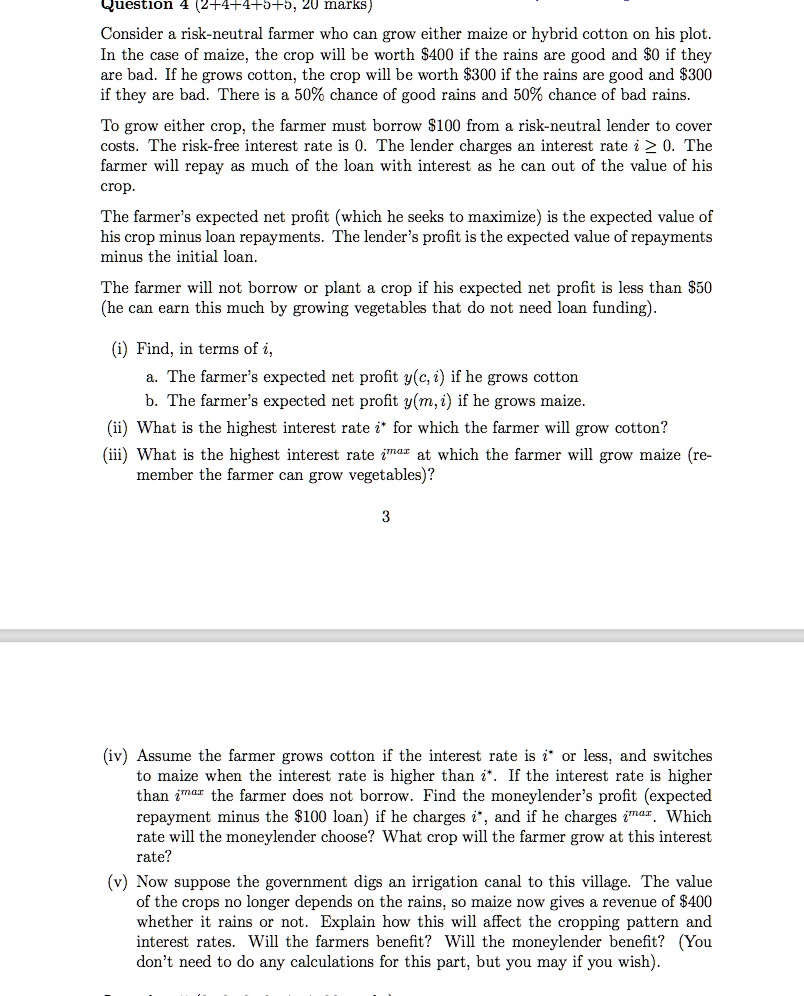
Question 4 (2+4+4+5+5, 20 marks)
Consider a risk-neutral farmer who can grow either maize or hybrid cotton on his plot.
In the case of maize, the crop will be worth $400 if the rains are good and $0 if they
are bad. If he grows cotton, the crop will be worth $300 if the rains are good and $300
if they are bad. There is a 50% chance of good rains and 50% chance of bad rains.
To grow either crop, the farmer must borrow $100 from a risk-neutral lender to cover
costs. The risk-free interest rate is 0. The lender charges an interest rate $i \ge 0$. The
farmer will repay as much of the loan with interest as he can out of the value of his
crop.
The farmer's expected net profit (which he seeks to maximize) is the expected value of
his crop minus loan repayments. The lender's profit is the expected value of repayments
minus the initial loan.
The farmer will not borrow or plant a crop if his expected net profit is less than $50
(he can earn this much by growing vegetables that do not need loan funding).
(i) Find, in terms of $i$,
a. The farmer's expected net profit $y(c, i)$ if he grows cotton
b. The farmer's expected net profit $y(m, i)$ if he grows maize.
(ii) What is the highest interest rate $i^*$ for which the farmer will grow cotton?
(iii) What is the highest interest rate $i^{max}$ at which the farmer will grow maize (re-
member the farmer can grow vegetables)?
3
(iv) Assume the farmer grows cotton if the interest rate is $i^*$ or less, and switches
to maize when the interest rate is higher than $i^*$. If the interest rate is higher
than $i^{max}$ the farmer does not borrow. Find the moneylender's profit (expected
repayment minus the $100 loan) if he charges $i^*$, and if he charges $i^{max}$. Which
rate will the moneylender choose? What crop will the farmer grow at this interest
rate?
(v) Now suppose the government digs an irrigation canal to this village. The value
of the crops no longer depends on the rains, so maize now gives a revenue of $400
whether it rains or not. Explain how this will affect the cropping pattern and
interest rates. Will the farmers benefit? Will the moneylender benefit? (You
don't need to do any calculations for this part, but you may if you wish).