1.3 Integral Calculus
25
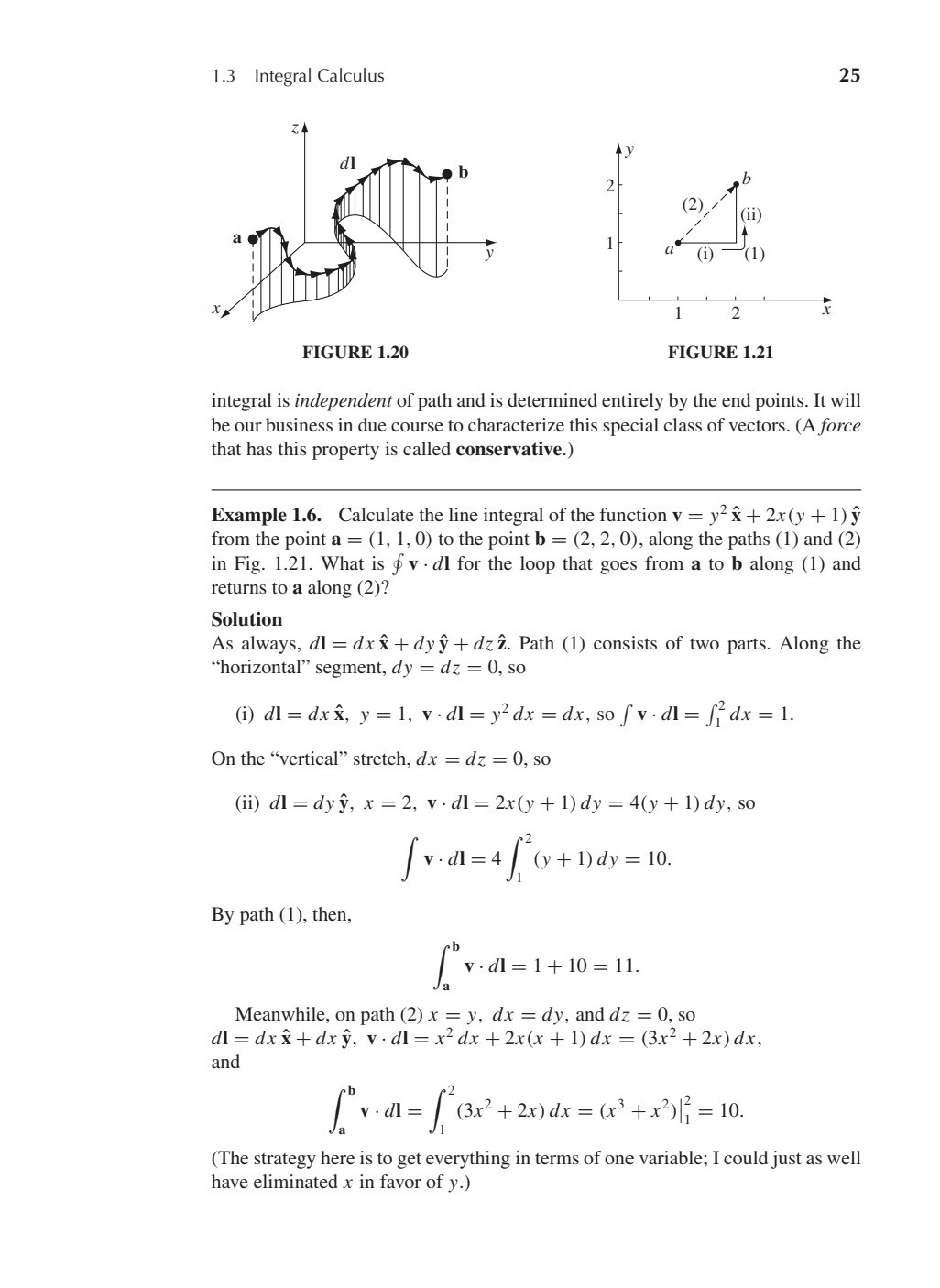
FIGURE 1.20
FIGURE 1.21
integral is independent of path and is determined entirely by the end points. It will be our business in due course to characterize this special class of vectors. (A force that has this property is called conservative.)
Example 1.6. Calculate the line integral of the function \( \mathbf{v}=y^{2} \hat{\mathbf{x}}+2 x(y+1) \hat{\mathbf{y}} \) from the point \( \mathbf{a}=(1,1,0) \) to the point \( \mathbf{b}=(2,2,0) \), along the paths (1) and (2) in Fig. 1.21. What is \( \oint \mathbf{v} \cdot d \mathbf{l} \) for the loop that goes from a to \( \mathbf{b} \) along (1) and returns to a along (2)?
Solution
As always, \( d \mathbf{l}=d x \hat{\mathbf{x}}+d y \hat{\mathbf{y}}+d z \hat{\mathbf{z}} \). Path (1) consists of two parts. Along the "horizontal" segment, \( d y=d z=0 \), so
(i) \( d \mathbf{l}=d x \hat{\mathbf{x}}, y=1, \mathbf{v} \cdot d \mathbf{l}=y^{2} d x=d x \), so \( \int \mathbf{v} \cdot d \mathbf{l}=\int_{1}^{2} d x=1 \).
On the "vertical" stretch, \( d x=d z=0 \), so
(ii) \( d \mathbf{l}=d y \hat{\mathbf{y}}, x=2, \mathbf{v} \cdot d \mathbf{l}=2 x(y+1) d y=4(y+1) d y \), so
\[
\int \mathbf{v} \cdot d \mathbf{l}=4 \int_{1}^{2}(y+1) d y=10
\]
By path (1), then,
\[
\int_{\mathbf{a}}^{\mathbf{b}} \mathbf{v} \cdot d \mathbf{l}=1+10=11
\]
Meanwhile, on path (2) \( x=y, d x=d y \), and \( d z=0 \), so
\[
d \mathbf{l}=d x \hat{\mathbf{x}}+d x \hat{\mathbf{y}}, \mathbf{v} \cdot d \mathbf{l}=x^{2} d x+2 x(x+1) d x=\left(3 x^{2}+2 x\right) d x
\]
and
\[
\int_{\mathbf{a}}^{\mathbf{b}} \mathbf{v} \cdot d \mathbf{l}=\int_{1}^{2}\left(3 x^{2}+2 x\right) d x=\left.\left(x^{3}+x^{2}\right)\right|_{1} ^{2}=10
\]
(The strategy here is to get everything in terms of one variable; I could just as well have eliminated \( x \) in favor of \( y \).)