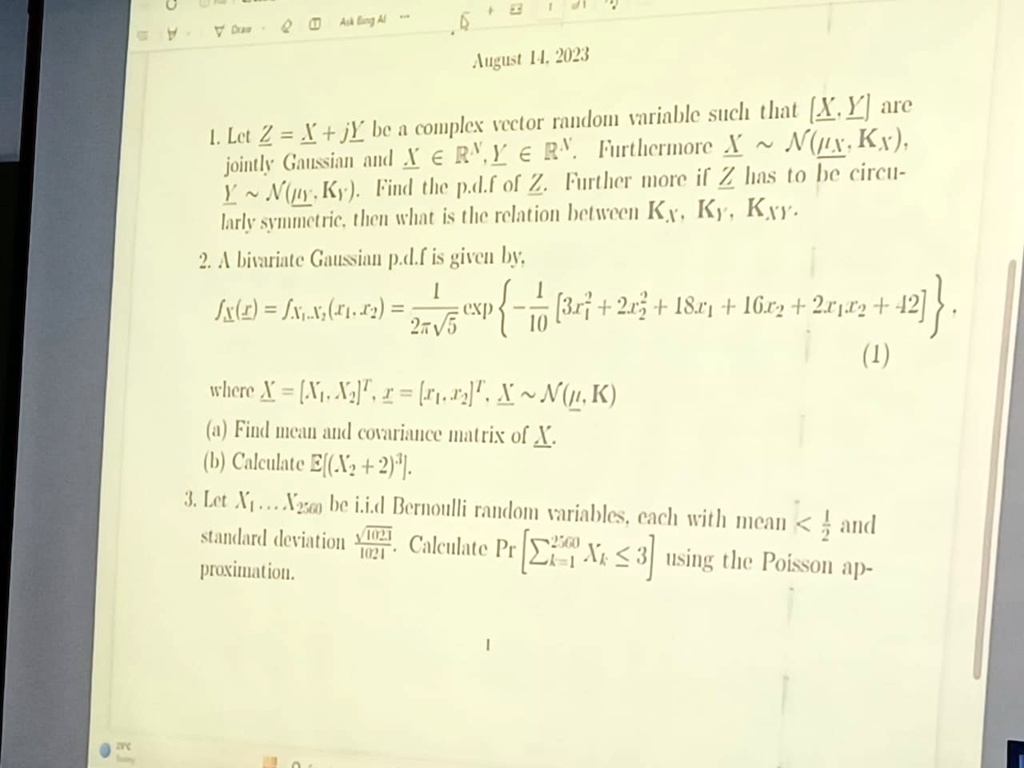
August 14, 2023
1. Let $Z = X + jY$ be a complex vector random variable such that $[X, Y]$ are
jointly Gaussian and $X \in \mathbb{R}^N$, $Y \in \mathbb{R}^N$. Furthermore $X \sim \mathcal{N}(\mu_X, K_X)$,
$Y \sim \mathcal{N}(\mu_Y, K_Y)$. Find the p.d.f of $Z$. Further more if $Z$ has to be circu-
larly symmetric, then what is the relation between $K_X$, $K_Y$, $K_{XY}$.
2. A bivariate Gaussian p.d.f is given by,
$f_X(x) = f_{X_1, X_2}(x_1, x_2) = \frac{1}{2\pi\sqrt{5}} \exp \left\{ -\frac{1}{10} [3x_1^2 + 2x_2^2 + 18x_1 + 16x_2 + 2x_1x_2 + 42] \right\}$ (1)
where $X = [X_1, X_2]^T$, $x = [x_1, x_2]^T$, $X \sim \mathcal{N}(\mu, K)$
(a) Find mean and covariance matrix of $X$.
(b) Calculate $E[(X_2 + 2)^2]$.
3. Let $X_1, \dots, X_{2500}$ be i.i.d Bernoulli random variables, each with mean $\leq \frac{1}{2}$ and
standard deviation $\frac{\sqrt{1023}}{1024}$. Calculate $Pr \left[\sum_{i=1}^{2500} X_i \leq 3\right]$ using the Poisson ap-
proximation.