Ace - AI Tutor
Ask Our Educators
Textbooks
My Library
Flashcards
Scribe - AI Notes
Notes & Exams
Download App
stephanie quiroga

stephanie q.

Divider

Questions asked

BEST MATCH

Consider the following function. f(x) = 12  x2 + 52  x − 32 Find all real zeros of the polynomial function. (Enter your answers as a comma-separated list. If there is no solution, enter NO SOLUTION.)

View Answer
divider
BEST MATCH

Rank the following atoms by number of valence electrons. Sb Br Xe Ga Rb

View Answer
divider
BEST MATCH

For part 1 of the answer, why does the -2T turn from - to positive and then again back to negative on the third line? Same with -2.5r, why does it change to +?

View Answer
divider
BEST MATCH

A length of aluminum wire is connected to a precision 10.00-V power supply, and a current of 0.4232 A is precisely measured at 23.5 $^\circ$C. The wire is placed in a new environment of unknown temperature where the measured current is 0.3778 A. The temperature coefficient of resistivity of aluminum is 0.00429 $(^\circ C)^{-1}$

View Answer
divider
BEST MATCH

What happens to consumer and producer surplus when a negative externality appears?

View Answer
divider
BEST MATCH

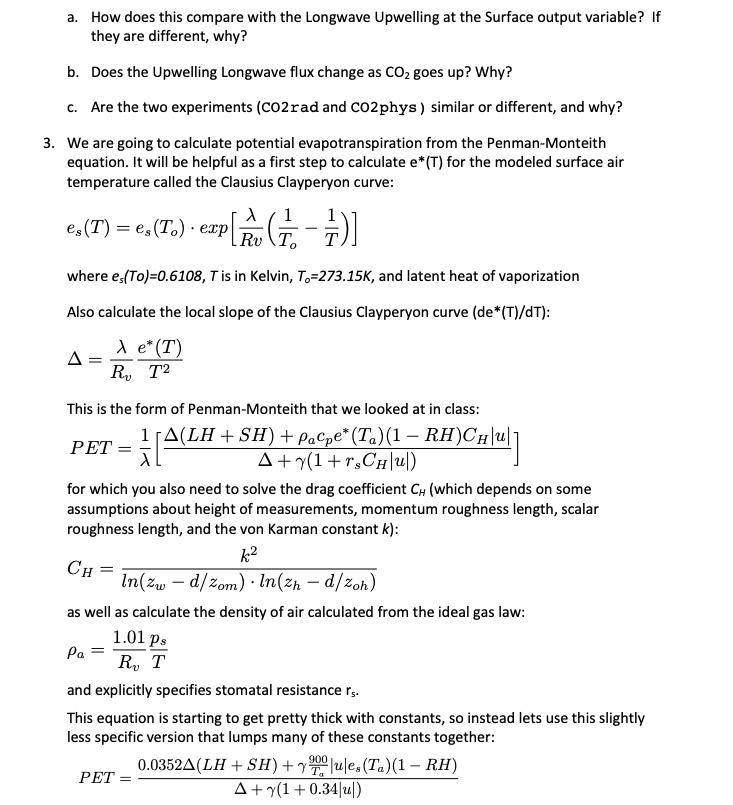
a. How does this compare with the Longwave Upwelling at the Surface output variable? If they are different, why? b. Does the Upwelling Longwave flux change as CO$_2$ goes up? Why? c. Are the two experiments (CO2rad and CO2phys) similar or different, and why? 3. We are going to calculate potential evapotranspiration from the Penman-Monteith equation. It will be helpful as a first step to calculate e*(T) for the modeled surface air temperature called the Clausius Clayperyon curve: $e_s(T) = e_s(T_0) \cdot exp[\frac{\lambda}{R_v} (\frac{1}{T_0} - \frac{1}{T})]$ where $e_s(T_0)$=0.6108, T is in Kelvin, $T_0$=273.15K, and latent heat of vaporization Also calculate the local slope of the Clausius Clayperyon curve (de*(T)/dT): $\Delta = \frac{\lambda}{R_v} \frac{e^*(T)}{T^2}$ This is the form of Penman-Monteith that we looked at in class: $PET = \frac{1}{\lambda} [\frac{\Delta (LH + SH) + \rho_a C_p e^*(T_a)(1 - RH)C_H|u|}{\Delta + \gamma (1 + r_s C_H|u|)}$ for which you also need to solve the drag coefficient $C_H$ (which depends on some assumptions about height of measurements, momentum roughness length, scalar roughness length, and the von Karman constant k): $C_H = \frac{k^2}{ln(z_w - d/z_{om}) \cdot ln(z_h - d/z_{oh})}$ as well as calculate the density of air calculated from the ideal gas law: $\rho_a = \frac{1.01 \rho_s}{R_v T}$ and explicitly specifies stomatal resistance $r_s$. This equation is starting to get pretty thick with constants, so instead lets use this slightly less specific version that lumps many of these constants together: $PET = 0.0352 \frac{\Delta (LH + SH) + \frac{900}{T} |u|e_s(T_a)(1 - RH)}{\Delta + \gamma (1 + 0.34|u|)}$
View Answer
divider
BEST MATCH

1. Consider a machine of mass 70 kg mounted to ground through an isolation system of total stiffness 30,000 N/m, with a measured damping ratio of 0.2. The machine produces a harmonic force of 450 N at 13 rad/s during steady-state operating conditions. Determine (a) the amplitude of motion of the machine, (b) the phase angle of the motion (c) the transmissibility ratio, (d) the maximum dynamic force transmitted to the floor.

View Answer
divider
BEST MATCH

14.103 The rod OA carrying the sliding collar of mass m is rotating about the vertical axis OB with the constant angular velocity $\omega$ = 10 rad/s when the string holding the collar in the position shown suddenly breaks. Determine the radial and transverse velocity components of the slider when it reaches the end of the guide rod at A. Neglect friction and the mass of the guide rod.

View Answer
divider
BEST MATCH

Question 39 Not yet answered Points out of 1 Flag question Suppose the currency-to-checkable deposit ratio decreases while, at the same time, the excess reserve-to-checkable deposit ratio also decreases. Everything else held constant, these changes would ____ the money supply.

View Answer
divider
BEST MATCH

Find the equation of the curve that passes through (1,3) given its slope equals $2x + 2$ at any point $(x, y)$. Give your answer in the form $y = f(x)$.

View Answer
divider