Problem 1: Performance Measures
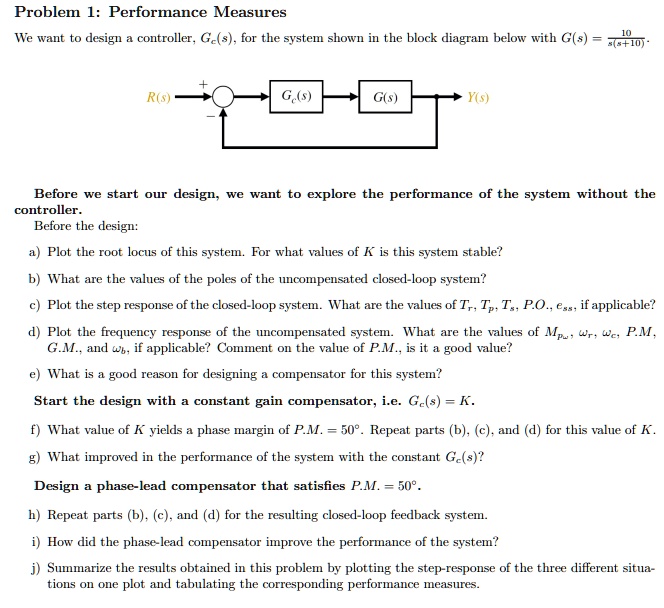
We want to design a controller, G_(c)(s), for the system shown in the block diagram below with G(s)=(10)/(s(s+10)).
Before we start our design, we want to explore the performance of the system without the
controller.
Before the design:
a) Plot the root locus of this system. For what values of K is this system stable?
b) What are the values of the poles of the uncompensated closed-loop system?
c) Plot the step response of the closed-loop system. What are the values of T_(r),T_(p),T_(s), P.O., e_(ss), if applicable?
d) Plot the frequency response of the uncompensated system. What are the values of M_(p_(omega )),omega _(r),omega _(c),P.M,
G.M., and omega _(b), if applicable? Comment on the value of P.M., is it a good value?
e) What is a good reason for designing a compensator for this system?
Start the design with a constant gain compensator, i.e. G_(c)(s)=K.
f) What value of K yields a phase margin of P.M. =50deg . Repeat parts (b), (c), and (d) for this value of K.
g) What improved in the performance of the system with the constant G_(c)(s) ?
Design a phase-lead compensator that satisfies P.M. =50deg .
h) Repeat parts (b), (c), and (d) for the resulting closed-loop feedback system.
i) How did the phase-lead compensator improve the performance of the system?
j) Summarize the results obtained in this problem by plotting the step-response of the three different situa-
tions on one plot and tabulating the corresponding performance measures.
Problem 1: Performance Measures
R(s)
G.(s)
G(s)
>Y(s)
Before we start our design, we want to explore the performance of the system without the controller. Before the design:
a) Plot the root locus of this system. For what values of K is this system stable?
b) What are the values of the poles of the uncompensated closed-loop system?
c) Plot the step response of the closed-loop system. What are the values of T., Tp, Ts, P.O., ess, if applicable?
d) Plot the frequency response of the uncompensated system. What are the values of Mp., r, e, P.M. G.M., and b, if applicable? Comment on the value of P.M., is it a good value?
e) What is a good reason for designing a compensator for this system?
Start the design with a constant gain compensator,i.e. G.s)= K.
f) What value of K yields a phase margin of P.M. = 50. Repeat parts (b), (c), and (d) for this value of K
g) What improved in the performance of the system with the constant G.(s)?
Design a phase-lead compensator that satisfies P.M. = 50.
h) Repeat parts (b), (c), and (d) for the resulting closed-loop feedback system.
i) How did the phase-lead compensator improve the performance of the system?
j) Summarize the results obtained in this problem by plotting the step-response of the three different situa. tions on one plot and tabulating the corresponding performance measures.