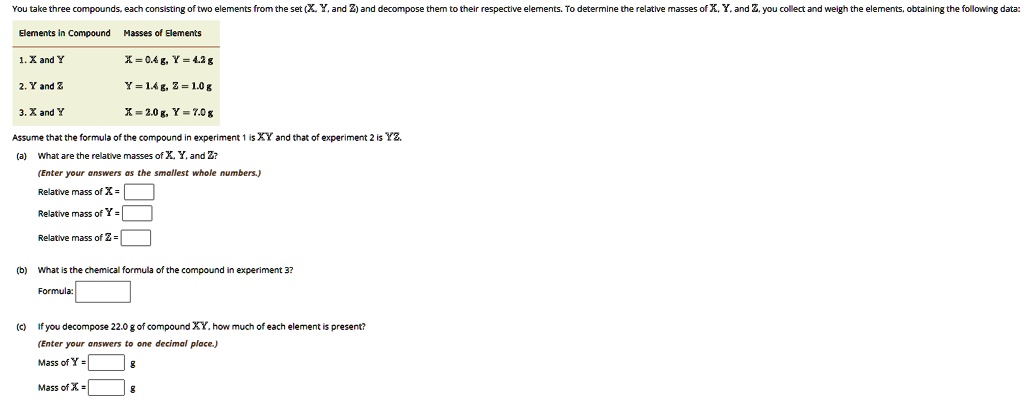
You take three compounds, each consisting of two elements from the set (X, Y, and Z) and decompose them to their respective elements. To determine the relative masses of X, Y, and Z, you collect and weigh the elements, obtaining the following data:
Elements in Compound Masses of Elements
1. X and Y
X=0.4g, Y = 4.2 g
2. Y and Z
Y=1.4g, Z = 1.0 g
3. X and Y
X=2.0 g, Y = 7.0 g
Assume that the formula of the compound in experiment 1 is XY and that of experiment 2 is YZ.
(a) What are the relative masses of X, Y, and Z?
(Enter your answers as the smallest whole numbers.)
Relative mass of X =
Relative mass of Y =
Relative mass of Z =
(b) What is the chemical formula of the compound in experiment 3?
Formula:
(c) If you decompose 22.0 g of compound XY, how much of each element is present?
(Enter your answers to one decimal place.)
Mass of Y =
g
Mass of X =
g