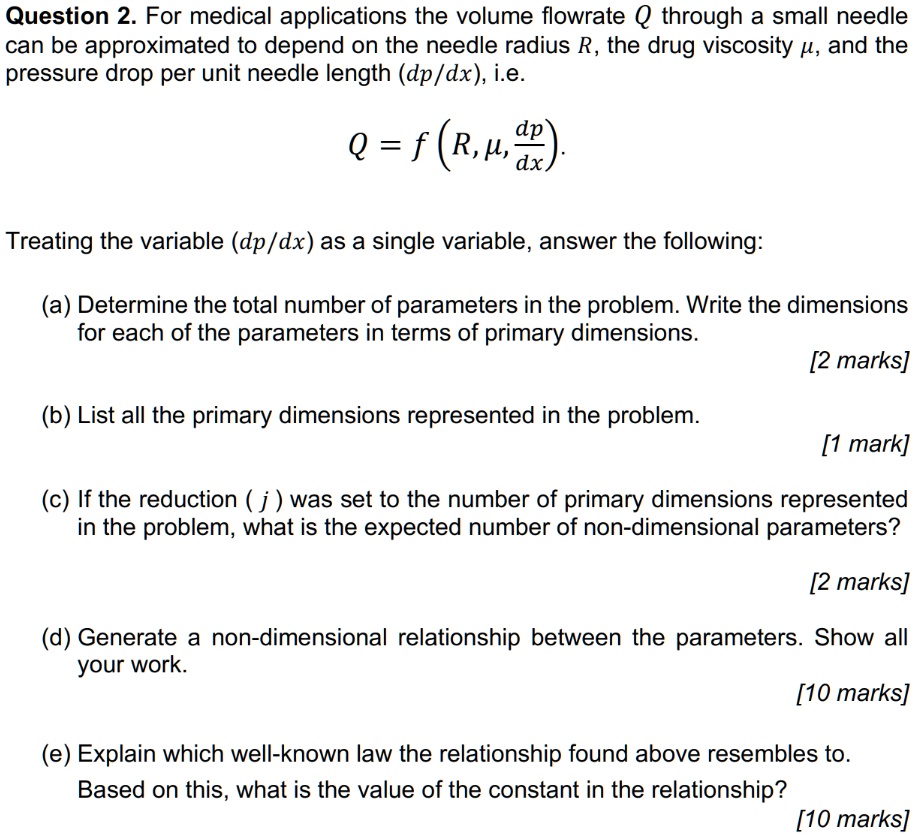
Question 2. For medical applications the volume flowrate Q through a small needle
can be approximated to depend on the needle radius R, the drug viscosity ?, and the
pressure drop per unit needle length ($dp/dx$), i.e.
$Q = f(R, ?, \frac{dp}{dx})$.
Treating the variable ($dp/dx$) as a single variable, answer the following:
(a) Determine the total number of parameters in the problem. Write the dimensions
for each of the parameters in terms of primary dimensions.
[2 marks]
(b) List all the primary dimensions represented in the problem.
[1 mark]
(c) If the reduction ($j$) was set to the number of primary dimensions represented
in the problem, what is the expected number of non-dimensional parameters?
[2 marks]
(d) Generate a non-dimensional relationship between the parameters. Show all
your work.
[10 marks]
(e) Explain which well-known law the relationship found above resembles to.
Based on this, what is the value of the constant in the relationship?
[10 marks]