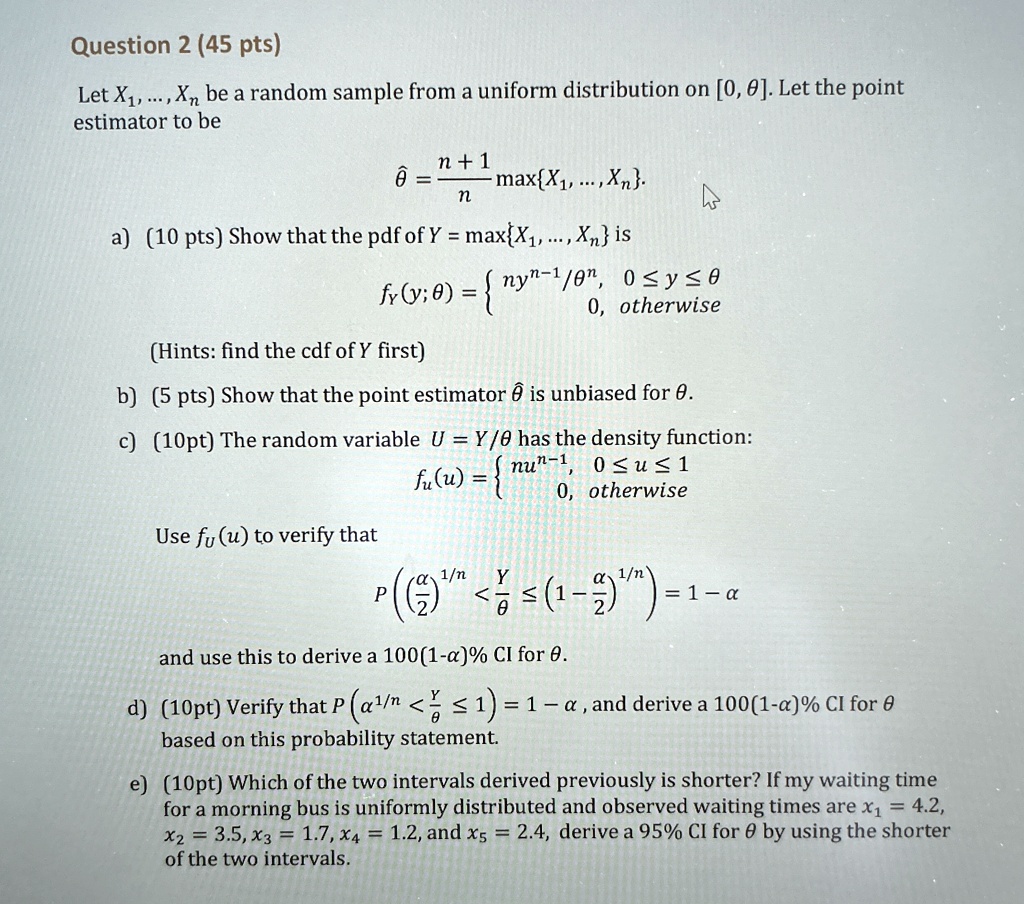
Question 2 (45 pts)
Let $X_1, ..., X_n$ be a random sample from a uniform distribution on $[0, \theta]$. Let the point estimator to be
$\hat{\theta} = \frac{n+1}{n} max\{X_1, ..., X_n\}$.
a) (10 pts) Show that the pdf of $Y = max\{X_1, ..., X_n\}$ is
$f_Y(y; \theta) = \begin{cases} n y^{n-1}/\theta^n, & 0 \le y \le \theta \\ 0, & otherwise \end{cases}$
(Hints: find the cdf of Y first)
b) (5 pts) Show that the point estimator $\hat{\theta}$ is unbiased for $\theta$.
c) (10pt) The random variable $U = Y/\theta$ has the density function:
$f_U(u) = \begin{cases} n u^{n-1}, & 0 \le u \le 1 \\ 0, & otherwise \end{cases}$
Use $f_U(u)$ to verify that
$P\left( \left( \frac{\alpha}{2} \right)^{1/n} < \frac{Y}{\theta} < \left( 1 - \frac{\alpha}{2} \right)^{1/n} \right) = 1 - \alpha$
and use this to derive a 100(1-$\alpha$)% CI for $\theta$.
d) (10pt) Verify that $P\left( \frac{\alpha}{n} < \frac{Y}{\theta} \le 1 \right) = 1 - \alpha$, and derive a 100(1-$\alpha$)% CI for $\theta$ based on this probability statement.
e) (10pt) Which of the two intervals derived previously is shorter? If my waiting time for a morning bus is uniformly distributed and observed waiting times are $x_1 = 4.2$, $x_2 = 3.5$, $x_3 = 1.7$, $x_4 = 1.2$, and $x_5 = 2.4$, derive a 95% CI for $\theta$ by using the shorter of the two intervals.