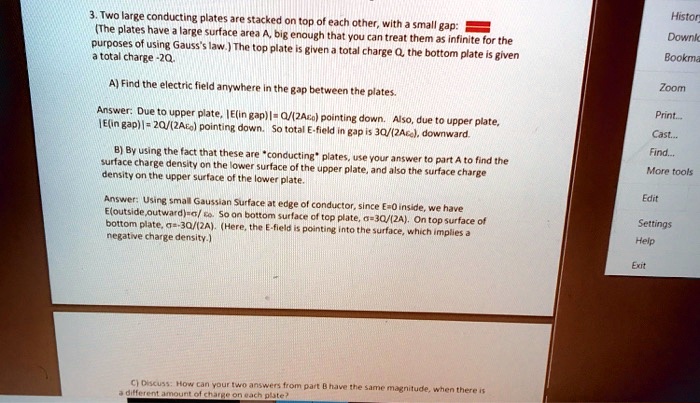
3. Two large conducting plates are stacked on top of each other, with a small gap:
(The plates have a large surface area A, big enough that you can treat them as infinite for the
purposes of using Gauss's law.) The top plate is given a total charge Q, the bottom plate is given
a total charge -2Q.
A) Find the electric field anywhere in the gap between the plates.
Answer: Due to upper plate, $|E(in\ gap)| = Q/(2A\epsilon_0)$ pointing down. Also, due to upper plate,
$|E(in\ gap)| = 2Q/(2A\epsilon_0)$ pointing down. So total E-field in gap is $3Q/(2A\epsilon_0)$, downward.
B) By using the fact that these are \textquotedbl{}conducting\textquotedbl{} plates, use your answer to part A to find the
surface charge density on the lower surface of the upper plate, and also the surface charge
density on the upper surface of the lower plate.
Answer: Using small Gaussian Surface at edge of conductor, since E=0 inside, we have
$E(outside,\ outward)/\epsilon_0 = \sigma/\epsilon_0$. So on bottom surface of top plate, $\sigma = 3Q/(2A)$. On top surface of
bottom plate, $\sigma = -3Q/(2A)$. (Here, the E-field is pointing into the surface, which implies a
negative charge density.)
C) Discuss: How can your two answers from part B have the same magnitude, when there is
a different amount of charge on each plate?