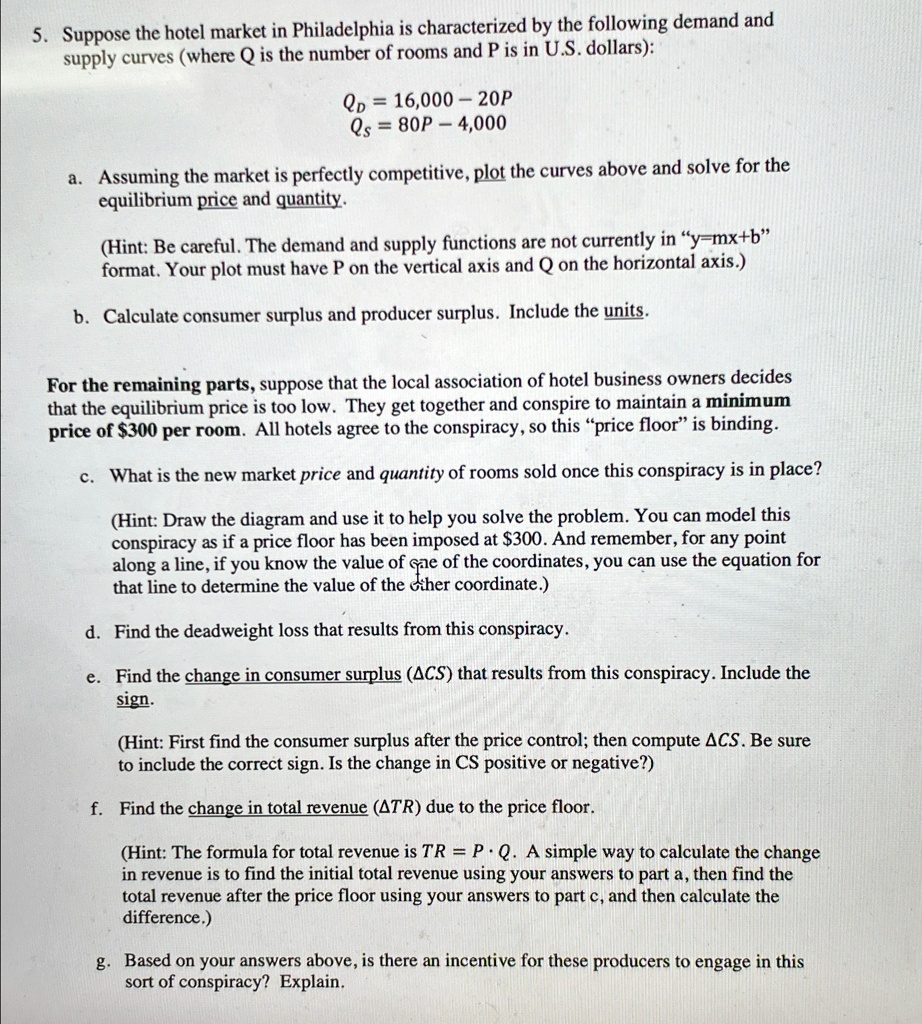
Suppose the hotel market in Philadelphia is characterized by the following demand and supply curves (where Q is the number of rooms and P is in U.S. dollars):
Q_(D)=16,000-20P
Q_(S)=80P-4,000
a. Assuming the market is perfectly competitive, plot the curves above and solve for the equilibrium price and quantity.
(Hint: Be careful. The demand and supply functions are not currently in " y=mx+b " format. Your plot must have P on the vertical axis and Q on the horizontal axis.)
b. Calculate consumer surplus and producer surplus. Include the units.
For the remaining parts, suppose that the local association of hotel business owners decides that the equilibrium price is too low. They get together and conspire to maintain a minimum price of $300 per room. All hotels agree to the conspiracy, so this "price floor" is binding.
c. What is the new market price and quantity of rooms sold once this conspiracy is in place?
(Hint: Draw the diagram and use it to help you solve the problem. You can model this conspiracy as if a price floor has been imposed at $300. And remember, for any point along a line, if you know the value of gae of the coordinates, you can use the equation for that line to determine the value of the ciher coordinate.)
d. Find the deadweight loss that results from this conspiracy.
e. Find the change in consumer surplus ( /_(/)CS ) that results from this conspiracy. Include the sign.
(Hint: First find the consumer surplus after the price control; then compute /_(/)CS. Be sure to include the correct sign. Is the change in CS positive or negative?)
f. Find the change in total revenue (Delta TR) due to the price floor.
(Hint: The formula for total revenue is TR=P*Q. A simple way to calculate the change in revenue is to find the initial total revenue using your answers to part a, then find the total revenue after the price floor using your answers to part c, and then calculate the difference.)
g. Based on your answers above, is there an incentive for these producers to engage in this sort of conspiracy? Explain.
5. Suppose the hotel market in Philadelphia is characterized by the following demand and supply curves (where Q is the number of rooms and P is in U.S.dollars): Qp=16,000-20P Qs=80P-4,000 a.Assuming the market is perfectly competitive, plot the curves above and solve for the equilibrium price and quantity Hint: Be careful. The demand and supply functions are not currently in "y=mx+b format.Your plot must have P on the vertical axis and Q on the horizontal axis.)
b.Calculate consumer surplus and producer surplus. Include the units.
For the remaining parts,suppose that the local association of hotel business owners decides that the equilibrium price is too low. They get together and conspire to maintain a minimum price of $300 per room. All hotels agree to the conspiracy, so this "price floor is binding.
c.What is the new market price and quantity of rooms sold once this conspiracy is in place?
(Hint:Draw the diagram and use it to help you solve the problem.You can model this conspiracy as if a price floor has been imposed at $300. And remember, for any point along a line, if you know the value of sae of the coordinates, you can use the equation for that line to determine the value of the Cther coordinate.)
d. Find the deadweight loss that results from this conspiracy
e.Find the change in consumer surplus (CS) that results from this conspiracy. Include the sign.
Hint: First find the consumer surplus after the price control; then compute CS.Be sure to include the correct sign.Is the change in CS positive or negative?
f. Find the change in total revenue TRdue to the price floor
Hint:The formula for total revenue is TR=PQ.A simple way to calculate the change in revenue is to find the initial total revenue using your answers to part a,then find the total revenue after the price floor using your answers to part c, and then calculate the difference.)
g.Based on your answers above, is there an incentive for these producers to engage in this sort of conspiracy?Explain.