Ace - AI Tutor
Ask Our Educators
Textbooks
My Library
Flashcards
Scribe - AI Notes
Notes & Exams
Download App
steven bell

steven b.

Divider

Questions asked

BEST MATCH

4. Consider a half-wave rectifier circuit shown in Fig. 3 that operates from a 120V(peak-to-peak) 60-Hz household supply. Use the constant-voltage-drop diode model with $V_D = 0.7V$. a) Find the turns ratio of the transformer required to provide an output voltage of 6V (peak-to-peak). b) Determine the conduction percentage of the diode.

View Answer
divider
BEST MATCH

Which of the following WAS identified as a major development reflecting changes in perceptions of children during the 20th century?Group of answer choiceslaws prohibiting marriage during childhood.the establishment of the first juvenile court.the passage of the childhood playgrounds act.manufacture of medicines specifically for children.

View Answer
divider
BEST MATCH

Situation 3: A hollow circular aluminum shaft with 150 mm outside diameter and 100 mm inside diameter limits its twist to 0.30 degrees per meter length and should not exceed a maximum shearing stress of 50 MPa. Use G=28 GPa. 18. Determine the effective polar moment of inertia. 19. Determine the value of torsion if shearing stress will govern. 20. Determine the value of torsion if the angle of twist will govern. 21. Determine the maximum value of torque that can be applied to the hollow circular shaft.

View Answer
divider
BEST MATCH

Werner said creative thinking A) involves microgenetic mobility B) utilizes primitive as well as advanced modes of thinking C) begins with undifferentiated impressions and images D) all of the above

View Answer
divider
BEST MATCH

Problem 2. Define a function $g: \mathbb{Z} \to \mathbb{N}$ given by the rule $g(n) = \begin{cases} 2n + 1 & ; n \ge 0 \\ -2n & ; n < 0 \end{cases}$ (1) Get a feel for the behavior of this function by filling in the following table: \begin{tabular}{|c|c|} \hline n & g(n) \\ \hline -4 & \\ -3 & \\ -2 & \\ -1 & \\ 0 & \\ 1 & \\ 2 & \\ 3 & \\ 4 & \\ \hline \end{tabular} (2) Prove that $g$ is injective. (3) Prove that $g$ is surjective.

View Answer
divider
BEST MATCH

1. Find the transfer function, $H(s) = \frac{V_o}{V_g}$ 2. Determine the location of the transfer's function poles and zeros. 3. Determine the circuit's step response, $v_g = u(t)$. 4. Determine the circuit's response to $v_g = 5cos(5t)u(t)$. 5. Determine the circuit's frequency response. 6. Determine the circuit's response to damped cosine, $v_g = 5e^{-0.1t}cos(5t)u(t)$

View Answer
divider
BEST MATCH

QUESTION 14 The most ideal metal for extrusion is ______(CLO2) (2points) steel aluminum titanium copper

View Answer
divider
BEST MATCH

This graph shows the potential energy vs position of a 3.58 kg particle confined to the x-axis. What is the force (in N), magnitude and direction, acting on the particle when it is at x = 11.3 m? Let A = 2 J. Include negative signs as appropriate for the direction. A force that acts in the positive x-direction would be considered positive, while a force that acts in the negative x-direction is considered negative.

View Answer
divider
BEST MATCH

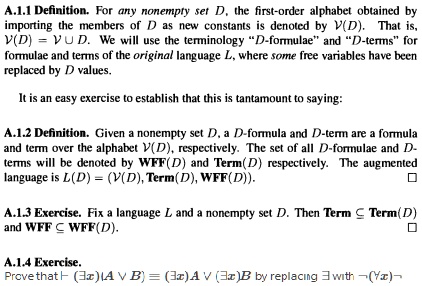
A.1.1 Definition. For any nonempty set D, the first-order alphabet obtained by importing the members of D as new constants is denoted by V(D). That is, V(D) = V U D. We will use the terminology D-formulae and D-terms for formulae and terms of the original language L, where some free variables have been replaced by D values. It is an easy exercise to establish that this is tantamount to saying: A.1.2 Definition. Given a nonempty set D, a D-formula and D-term are a formula and term over the alphabet V(D), respectively. The set of all D-formulae and D-terms will be denoted by WFF(D) and Term(D) respectively. The augmented language is L(D) = V(D), Term(D), WFF(D). A.1.3 Exercise. Fix a language L and a nonempty set D. Then Term ⊆ Term(D) and WFF ⊆ WFF(D). A.1.4 Exercise. Prove that F((A V B) √(3) A V (√B) by replacing √ with -V)
View Answer
divider
BEST MATCH

A monopolist faces an inverse demand given by $P = 1020 - 10Q$ where $P$ is the price of of the good they sell and $Q$ represents the quantity produced and sold at the market price $P$. The monopolist's cost function is given by $C(Q) = 10,000 + 20Q$ where $Q$ is the quantity produced and $C$ represents the cost in dollars. a) [30P] Find the optimal price and quantity that the monopolist would choose under the assumption that their goal is to maximize profits. Show all of the steps required to arrive at the solution.¹ b) [20P] Compute the profits of this monopolist. Show all of the steps required to arrive at the solution. c) [30P] In a diagram with the market demand, identify the deadweight loss (DWL) arising from this monopoly (DWL shape depends on demand and cost functions so make sure your sketch resemble the shapes of the particular cost and demand functions in this problem) and then compute this amount. Hint: the size of a DWL is typically the area of some \"triangle\". Area of a triangle is just base*height. See sections 9.3 and 9.4 in the textbook. d) [20P] Now assume that the government imposes a tax/unit of $100. Find (and show all of the steps required) the optimal price and quantity in the presence of this tax. Does the monopolist pass the whole tax to consumers? Hint: compare the prices consumers would pay without a tax, versus the new price the monopolist charges if there is a tax.

View Answer
divider