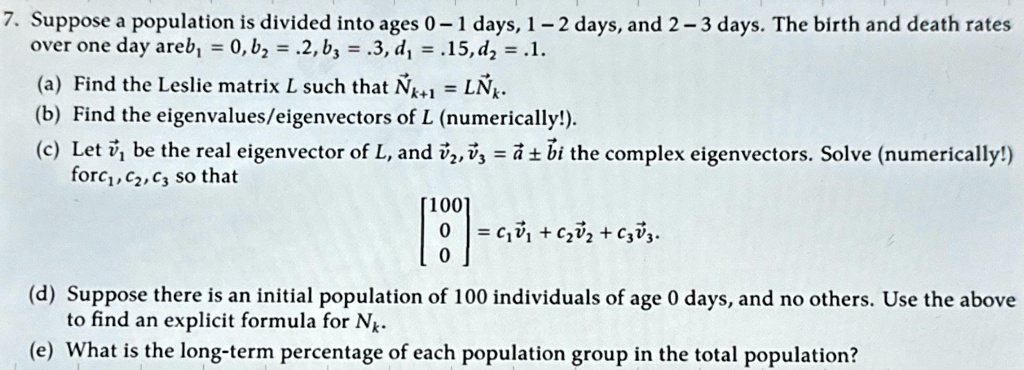
Suppose a population is divided into ages 0-1 days, 1-2 days, and 2-3 days. The birth and death rates over one day are b₁=0, b₂=0.2, b₃=0.3, d₁=0.15, d₂=0.1.
(a) Find the Leslie matrix L such that vec(N)ₖ₊₁=Lvec(N)ₖ.
(b) Find the eigenvalues/eigenvectors of L (numerically!).
(c) Let vec(v)₁ be the real eigenvector of L, and vec(v)₂, vec(v)₃=a±bi the complex eigenvectors. Solve (numerically!) for c₁, c₂, c₃ so that
[[100],[0],[0]]=c₁vec(v)₁+c₂vec(v)₂+c₃vec(v)₃.
(d) Suppose there is an initial population of 100 individuals of age 0 days, and no others. Use the above to find an explicit formula for Nₖ.
(e) What is the long-term percentage of each population group in the total population?
7. Suppose a population is divided into ages 0-1 days, 1-2 days, and 2-3 days. The birth and death rates over one day are b=0, b=0.2, b=0.3, d=0.15, d=0.1.
(a) Find the Leslie matrix L such that Nₖ₊₁ = LN (b) Find the eigenvalues/eigenvectors of L (numerically!) (c) Let , be the real eigenvector of L, and , =a bi the complex eigenvectors. Solve (numerically!) for c₁, c₂, c so that [100] 0 =c₁+c₂+c
(d) Suppose there is an initial population of 100 individuals of age 0 days, and no others. Use the above to find an explicit formula for Nₖ (e) What is the long-term percentage of each population group in the total population?