Ace - AI Tutor
Ask Our Educators
Textbooks
My Library
Flashcards
Scribe - AI Notes
Notes & Exams
Download App
steven mccoy

steven m.

Divider

Questions asked

BEST MATCH

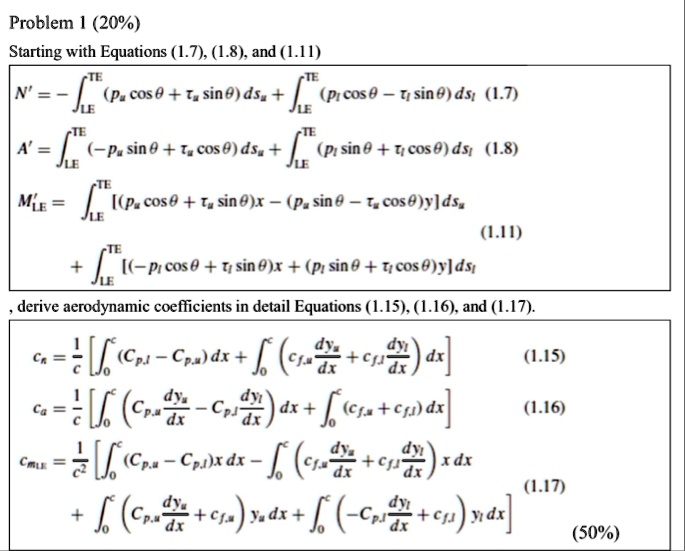
Problem 1 (20%) Starting with Equations (1.7), (1.8), and (1.11) N^(')=-\int_(LE)^(TE) (p_(u)cos\theta \tau _(u)sin\theta )ds_(u) \int_(LE)^(TE) (p_(l)cos\theta -\tau _(l)sin\theta )ds_(l) A^(')=\int_(LE)^(TE) (-p_(u)sin\theta \tau _(u)cos\theta )ds_(u) \int_(LE)^(TE) (p_(l)sin\theta \tau _(l)cos\theta )ds_(l) M_(LE)^(')=\int_(LE)^(TE) [(p_(u)cos\theta \tau _(u)sin\theta )x-(p_(u)sin\theta -\tau _(u)cos\theta )y]ds_(u) \int_(LE)^(TE) [(-p_(l)cos\theta \tau _(l)sin\theta )x (p_(l)sin\theta \tau _(l)cos\theta )y]ds_(l) , derive aerodynamic coefficients in detail Equations (1.15), (1.16), and (1.17).
View Answer
divider
BEST MATCH

Find all m∈N such that m+2001⋅S(m)=2m, where S(m) denotes the sum of the digits of m?

View Answer
divider
BEST MATCH

A Tootsie Pop is a sucker with a chocolate candy center. In a famous commercial the question was asked \"How many licks does it take to get to the center of a Tootsie Pop?\" The internet said that the mean number of licks it takes to get to the center is 678 licks. We know not everything you read on the internet is true so you conduct your own experiment. You got a random sample of 50 people to count the number of licks required to reach the chocolate center. The mean number of licks was 610.8 with a standard deviation of 182.8. Do these data provide strong evidence that the number of licks it takes to get to the center of a Tootsie pop is different than the mean posted on the internet. Use $\alpha = 0.002$. $H_0: \mu = 678$ $H_A: \mu \neq 678$ Consider the conditions for the hypothesis test. Select all that are true. The population is normally distributed. The sample size is less than 30, $n < 30$ This is a random sample or a randomized experiment. These observations are not independent because $n > 0.05N$, since there are more than 1000 Tootsie Pops that were made. The population is a distribution with an unknown shape. These observations are independent because $n \leq 0.05N$, since there are more than 1000 Tootsie Pops that were made. This is not a random sample nor a randomized experiment. The sample size is greater than or equal to 30, $n \geq 30$ Are the conditions satisfied to perform the hypothesis test? $\circ$ no $\circ$ yes

View Answer
divider
BEST MATCH

Question 5 10 pts A 0.43-kg particle moves in a circle of radius R = 0.18 m at constant speed. The time for 27 complete revolutions is 32.6 s. What is the speed v of the particle? Express your answer in m/s. I

View Answer
divider
BEST MATCH

5. Given the following rules, show the fuzzy inferences for all the rules and the aggregation if temperature is 65 and pressure is 30 and calculate the COG. IF temperature is normal OR pressure is low THEN velocity is medium IF temperature is normal AND pressure is normal THEN velocity is low IF temperature is high THEN velocity is high

View Answer
divider
BEST MATCH

Non-disjunction would explain which of the following Aneuploidy Hemophilia Huntington disease Polydactyly

View Answer
divider
BEST MATCH

Which of the following computer hardware components is volatile in nature?

View Answer
divider
BEST MATCH

What are the types of future cash flows a firm might discount as part of the process of making investment decisions? After that, explain the advantages and disadvantages of each of the main discounted cash flow techniques You can use arithmetical examples for illustration purposes.

View Answer
divider
BEST MATCH

Draw the major product of this reaction. Include stereochemistry if applicable. Ignore byproducts (CH$_3$)COK heat Drawing Atoms, Bonds and Rings Charges Draw or tap a new bond to see suggestions Undo Reset Remove Done

View Answer
divider
BEST MATCH

Texts: Consider a well-stirred reactor with an irreversible reaction with a first-order reaction rate: A → products, r = k * cA. From a mass balance, we obtain the equation: V * (dcA)/(dt) = q * (cAf - cA) - k * V * cA. a) Solve this equation with the initial condition, cA = cA0 at t = 0. b) Draw a curve of cA(t) using the solution obtained in a). What is the value that cA approaches as t → ∞? How long does it take for cA to be within a 5% error bound of the asymptotic value? c) Repeat b) with a different set of values for the physical parameters (draw two curves together). Compare the two results (How does the value of kV/q influence the time scale? How can we analyze this?).

View Answer
divider