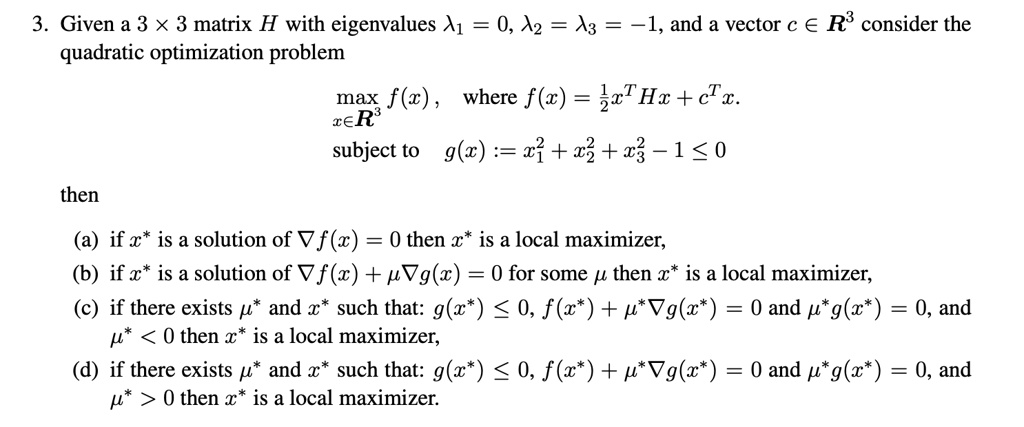
3. Given a 3 × 3 matrix $H$ with eigenvalues $\lambda_1 = 0$, $\lambda_2 = \lambda_3 = -1$, and a vector $c \in \mathbb{R}^3$ consider the
quadratic optimization problem
$\max_{x \in \mathbb{R}^3} f(x)$, where $f(x) = \frac{1}{2}x^T Hx + c^T x$.
subject to $g(x) := x_1^2 + x_2^2 + x_3^2 - 1 \le 0$
then
(a) if $x^*$ is a solution of $\nabla f(x) = 0$ then $x^*$ is a local maximizer,
(b) if $x^*$ is a solution of $\nabla f(x) + \mu \nabla g(x) = 0$ for some $\mu$ then $x^*$ is a local maximizer,
(c) if there exists $\mu^*$ and $x^*$ such that: $g(x^*) \le 0$, $f(x^*) + \mu^* \nabla g(x^*) = 0$ and $\mu^* g(x^*) = 0$, and
$\mu^* < 0$ then $x^*$ is a local maximizer,
(d) if there exists $\mu^*$ and $x^*$ such that: $g(x^*) \le 0$, $f(x^*) + \mu^* \nabla g(x^*) = 0$ and $\mu^* g(x^*) = 0$, and
$\mu^* > 0$ then $x^*$ is a local maximizer.