Ace - AI Tutor
Ask Our Educators
Textbooks
My Library
Flashcards
Scribe - AI Notes
Notes & Exams
Download App
steven moody

steven m.

Divider

Questions asked

BEST MATCH

A major factor in the cause and treatment of ADHD is abnormal levels of Group of answer choices all of these serotonin GABA oxytocin dopamine

View Answer
divider
BEST MATCH

The function g is related to one of the parent functions. g(x) = −4x2 + 2 (a) Identify the parent function f. f(x) =

View Answer
divider
BEST MATCH

Write the systematic name of each organic molecule: structure name HO O H H O OH OH H O H

View Answer
divider
BEST MATCH

Mr beluga is most likely in the what stage of dying ?

View Answer
divider
BEST MATCH

27.5% of the nucleotide bases in a particular species’ DNA are C. What percent of the bases are T?

View Answer
divider
BEST MATCH

1H nuclei located near electronegative atoms tend to be ________ relative to 1H nuclei which are not.

View Answer
divider
BEST MATCH

Find A with arrow ⨯ B with arrow for the following choices: (a) A with arrow = 2î and B with arrow = 7î + 7ĵ A with arrow ⨯ B with arrow = (b) A with arrow = 2î and B with arrow = 7î + 7k A with arrow ⨯ B with arrow = (c) A with arrow = 5î + 10ĵ and B with arrow = 10î + 5ĵ A with arrow ⨯ B with arrow =

View Answer
divider
BEST MATCH

Part F Now, remove the negative charge, and drag two positive charges, placing them 1 m apart, as shown below. Equipotential 8.468 V +1 nC -1 nC Sensors What is the voltage at the midpoint of the two charges? Greater than zero, but less than twice the voltage produced by only one of the charges at the same point Zero Exactly twice the voltage produced by only one of the charges at the same point Submit Previous Answers Request Answer Incorrect; Try Again; 5 attempts remaining The electric field is zero at the midpoint, but the voltage is not zero. Electric Field Direction only Voltage Values Grid

View Answer
divider
BEST MATCH

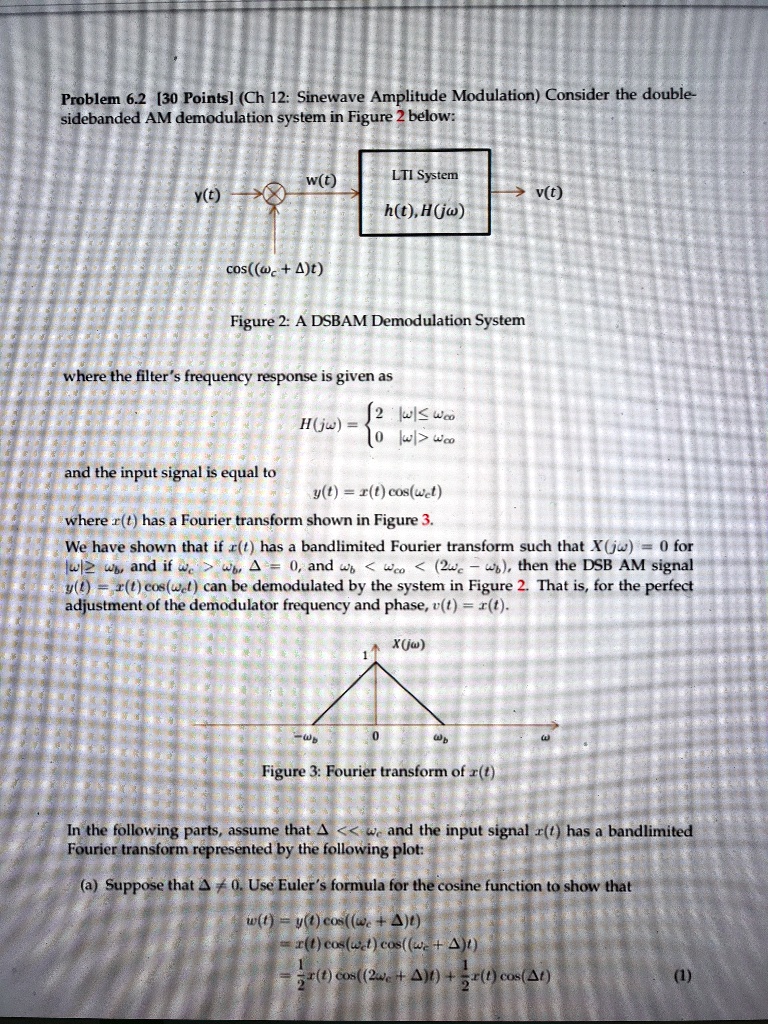
(b) Use the result in Equation 1 and the modulation property of the Fourier Transform to obtain W(jω) in terms of X(jω). Then plot W(jω). (c) Assuming that ωco = ωb + Δ, find V(jω) in terms of X(jω). Relate your result to the plot of W(jω). (d) From the equation of V(jω) and modulation property of the Fourier transform, obtain an equation for v(t) in terms of x(t) and Δ. Problem 6.2 [30 Points] (Ch 12: Sinewave Amplitude Modulation) Consider the double sidebanded AM demodulation system in Figure 2 below: wt XX LTI System v(t) >vt ht, H(jω) cos((ωt) Figure 2: A DSBAM Demodulation System where the filter's frequency response is given as: 2ω0H(jω) = 0 for |ω| > ω0 and the input signal is equal to: yt = x(t)cos(ωct) where t has a Fourier transform shown in Figure 3. We have shown that if t has a bandlimited Fourier transform such that X(jω) = 0 for |ω| > ωb and if ωb = 0, and ω < ωco < 2ωc, then the DSB AM signal y(t) = x(t)cos(ωct) can be demodulated by the system in Figure 2. That is, for the perfect adjustment of the demodulator frequency and phase, v(t) = x(t). X(jω) -ωb Figure 3: Fourier transform of x(t) In the following parts, assume that ωe and the input signal x(t) has a bandlimited Fourier transform represented by the following plot: (a) Suppose that ω = 0. Use Euler's formula for the cosine function to show that: wt = ycos(ωc + Δt) + x(t)cos(ωc - Δt) (1)
View Answer
divider
BEST MATCH

For part b, one possible solution is as follows, which would be saved as plot3_17.m: a = 0.25:0.01:4; b = a+2; [V, A] = torus3_17(a, b); plot(a, V, a, A) %Line b1 %Line b2 %Line b3 %Line b4 Question 17b1: Which part of Line b1 is not specified in the original problem? Question 17b2: Why is a dot not needed in Line b2? Question 17b3: Explain what Line b3 is doing. Question 17b4: Explain what Line b4 is doing.

View Answer
divider