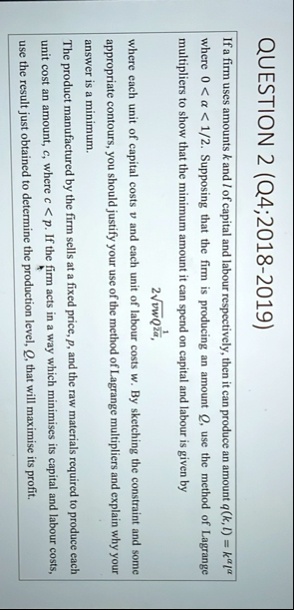
QUESTION 2 (Q4;2018-2019)
If a firm uses amounts k and l of capital and labour respectively, then it can produce an amount q(k, l) = $k^{\alpha}l^{\alpha}$
where 0 < $\alpha$ < 1/2. Supposing that the firm is producing an amount Q, use the method of Lagrange
multipliers to show that the minimum amount it can spend on capital and labour is given by
$\frac{1}{2\sqrt{vw}Q^{\frac{1}{2\alpha}}}$,
where each unit of capital costs v and each unit of labour costs w. By sketching the constraint and some
appropriate contours, you should justify your use of the method of Lagrange multipliers and explain why your
answer is a minimum.
The product manufactured by the firm sells at a fixed price, p, and the raw materials required to produce each
unit cost an amount, c, where c <p. If the firm acts in a way which minimises its capital and labour costs,
use the result just obtained to determine the production level, Q, that will maximise its profit.