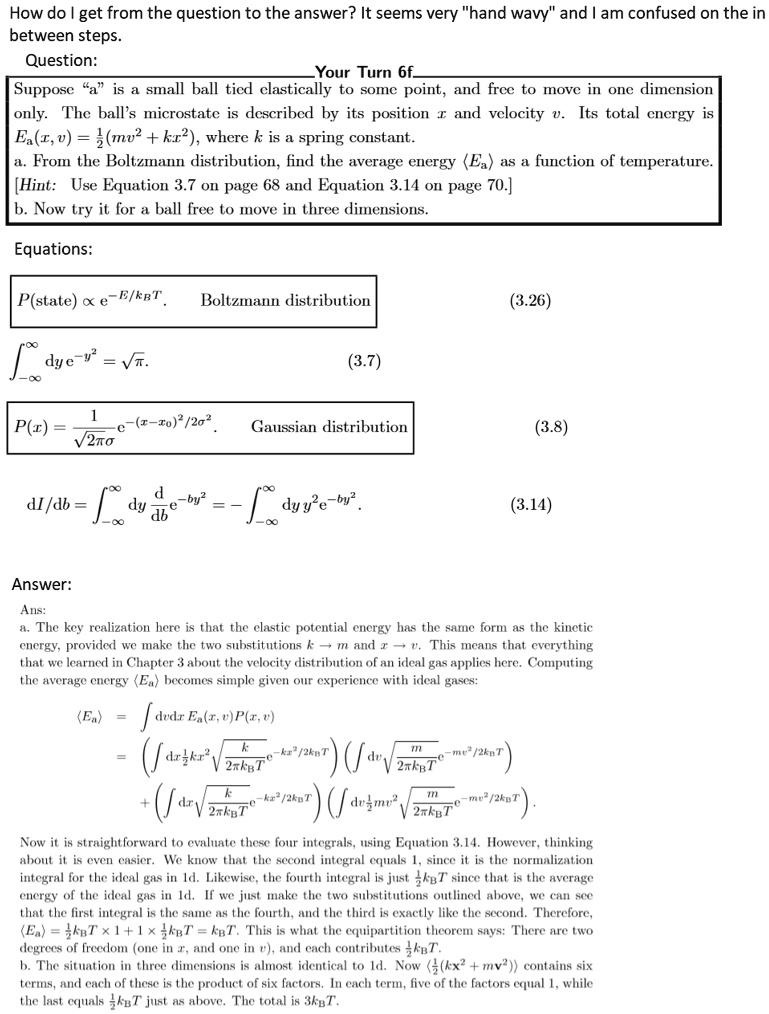
How do I get from the question to the answer? It seems very "hand wavy" and I am confused on the in
between steps.
Question:
Your Turn 6f.
Suppose "a" is a small ball tied elastically to some point, and free to move in one dimension
only. The ball's microstate is described by its position $x$ and velocity $v$. Its total energy is
$E_a(x, v) = \frac{1}{2}(mv^2 + kx^2)$, where $k$ is a spring constant.
a. From the Boltzmann distribution, find the average energy $\langle E_a \rangle$ as a function of temperature.
[Hint: Use Equation 3.7 on page 68 and Equation 3.14 on page 70.]
b. Now try it for a ball free to move in three dimensions.
Equations:
$P(\text{state}) \propto e^{-E/k_BT}$. Boltzmann distribution
$\int_{-\infty}^{\infty} dy \, e^{-y^2} = \sqrt{\pi}$.
$P(x) = \frac{1}{\sqrt{2\pi\sigma}}e^{-(x-\bar{x})^2/2\sigma^2}$. Gaussian distribution
$\frac{dI}{db} = \int_{-\infty}^{\infty} dy \, e^{-by^2} = -\int_{-\infty}^{\infty} dy \, y^2 e^{-by^2}$.
Answer:
Ans:
a. The key realization here is that the elastic potential energy has the same form as the kinetic
energy, provided we make the two substitutions $k \to m$ and $x \to v$. This means that everything
that we learned in Chapter 3 about the velocity distribution of an ideal gas applies here. Computing
the average energy $\langle E_a \rangle$ becomes simple given our experience with ideal gases:
$\langle E_a \rangle = \int dv dz \, E_a(x, v) P(x, v)$
$= \left( \int dx \, \sqrt{\frac{k}{2\pi k_B T}} e^{-kx^2/2k_BT} \right) \left( \int dv \, \sqrt{\frac{m}{2\pi k_B T}} e^{-mv^2/2k_BT} \right)$
$+ \left( \int dx \, \sqrt{\frac{k}{2\pi k_B T}} e^{-kx^2/2k_BT} \right) \left( \int dv \, \frac{m}{2\pi k_B T} e^{-mv^2/2k_BT} \right).$
Now it is straightforward to evaluate these four integrals, using Equation 3.14. However, thinking
about it is even easier. We know that the second integral equals 1, since it is the normalization
integral for the ideal gas in 1d. Likewise, the fourth integral is just $k_BT$ since that is the average
energy of the ideal gas in 1d. If we just make the two substitutions outlined above, we can see
that the first integral is the same as the fourth, and the third is exactly like the second. Therefore,
$\langle E_a \rangle = \frac{1}{2}k_BT \times 1 + \frac{1}{2}k_BT = k_BT$. This is what the equipartition theorem says: There are two
degrees of freedom (one in $x$, and one in $v$), and each contributes $\frac{1}{2}k_BT$.
b. The situation in three dimensions is almost identical to 1d. Now $(\frac{1}{2}(kx^2 + mv^2))$ contains six
terms, and each of these is the product of six factors. In each term, five of the factors equal 1, while
the last equals $k_BT$ just as above. The total is $3k_BT$.