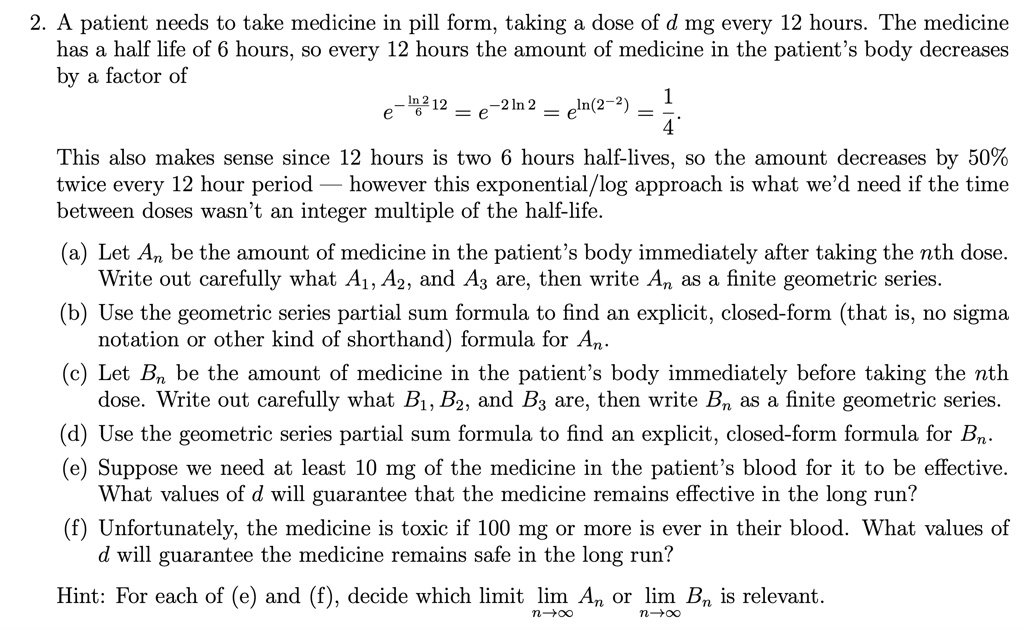
2. A patient needs to take medicine in pill form, taking a dose of d mg every 12 hours. The medicine has a half life of 6 hours, so every 12 hours the amount of medicine in the patient's body decreases by a factor of eln(2-2) 4
This also makes sense since 12 hours is two 6 hours half-lives, so the amount decreases by 50% twice every 12 hour period -- however this exponential/log approach is what we'd need if the time between doses wasn't an integer multiple of the half-life.
(a) Let An be the amount of medicine in the patient's body immediately after taking the nth dose. Write out carefully what A1, A2, and A3 are, then write An as a finite geometric series. (b) Use the geometric series partial sum formula to find an explicit, closed-form (that is, no sigma notation or other kind of shorthand) formula for An:
(c) Let Bn be the amount of medicine in the patient's body immediately before taking the nth dose. Write out carefully what Bi, B2, and B3 are, then write Bn as a finite geometric series.
(d) Use the geometric series partial sum formula to find an explicit, closed-form formula for Bn:
(e) Suppose we need at least 10 mg of the medicine in the patient's blood for it to be effective What values of d will guarantee that the medicine remains effective in the long run?
(f) Unfortunately, the medicine is toxic if 100 mg or more is ever in their blood. What values of d will guarantee the medicine remains safe in the long run?
Hint: For each of (e) and (f), decide which limit lim An or lim Bn is relevant. n- n