Case Study
Pulmonary Edema
ADMITTING HISTORY
A 68-year-old hypertensive man arrived in the emergency department via ambulance at 6:45 AM. The patient's wife stated that her husband had been doing well until the evening before admission, when he complained of being tired and short of breath. She also noted that he had demonstrated a sudden onset of dry, nonproductive cough. Thinking that he was getting a "touch of the flu," she gave her husband some hot soup, two aspirins, and a tablespoon of Robitussin and made him go to bed at about 8:30 PM. She stated that she had awoken about 4:30 AM to find her husband sitting up in bed, gasping for air. Alarmed, she had called 911.
The man's history shows that he had been in fairly good health since his retirement as a plumber 2 year ago. He has smoked about one pack of cigarettes a day for the past 40 years. For the past 2 years he and his wife have actively devoted most of their time to gardening and travel. They are planning a cross-country trailer trip to Alaska. About 1 year ago the man underwent a physical examination in preparation for this trip. At that time his physician placed him on digoxin and furosemide (Lasix) to treat atrial fibrillation and mild congestive heart failure, and the man quit smoking.
On the patient's arrival at the treatment room the emergency room nurse immediately placed him in a high Fowler's position. The respiratory therapist started oxygen at 2(L)/(m)in by nasal cannula. His wife appeared anxious. She was sobbing and walking back and forth, stating repeatedly, "Bill takes a heart pill and a water pill, and he follows a low-salt diet-just like the doctor told him to do."
PHYSICAL
EXAMINATION
On inspection the patient was in obvious respiratory distress. The man stated, however, "I don't think I'm having a serious problem." He further stated, "My wife and I are only 2 days away from our dream trip to Alaska. We've been planning this trip for 8 years! I can't believe this! ... It is just 2 days before we are supposed to leave, and here I am on this emergency room gurney!"
His vital signs were as follows: blood pressure 100/50, heart rate 145bpm and irregular, and respiratory rate (22)/(m)in.
The man was afebrile. His throat was reddened.
On 2(L)/(m)in oxygen, his oxygen saturation measured by pulse oximetry (Spo_(2)) was 70%.
His lips were blue, his neck veins were distended, he appeared very anxious, and he was coughing frequently, producing small amounts of frothy, pink secretions.
His abdomen was distended, and pitting edema was present to the midcalf area.
Palpation of his chest was unremarkable.
Dull percussion notes were elicited over the lower lung regions bilaterally.
Auscultation revealed inspiratory crackles and expiratory wheezing over the left and right lower lung regions.
His arterial blood gases (ABGs) on 2(L)/(m)in oxygen by nasal cannula were as follows: pH7.56,PacO_(2)28mmHg, HCO_(3)^(-)20mmo(l)/(L), and PaO_(2)51mmHg.
According to the radiologist's report, his chest x-ray showed faint opacities over the lower lung areas bilaterally. The x-ray report also noted that the patient's heart was moderately enlarged, suggesting left ventricular hypertrophy.
The emergency room physician started the patient on intravenous digitalis, dobutamine, and furosemide.
The physician ordered another chest x-ray film and asked the respiratory care consult service to see the patient. He specifically requested that respiratory care personnel monitor the patient closely over the next several hours.
Response 1
S
O
A
P
Time:
1100
The repeat bedside chest x-ray showed no remarkable improvement. The patient stated, "I still don' feel great."
His vital signs were as follows: blood pressure 160/90, heart rate 105bpm and regular rhythm, respiratory rate (20)/(m)in, and temperature 37.1deg C(98.8deg F).
The color of his lips had improved slightly, but no improvement was apparent in the patient's distended neck veins.
The nurse noted that the man's urine output over the past 2 hours had been 650ml.
The patient still coughed frequently; however, no frothy, pink sputum was noted at this time.
Ausculation continued to reveal inspiratory crackles and expiratory wheezing over the lower lung lobes bilaterally.
His Spo_(2) was 84%. His ABG study revealed a pH 7.54, PaCO_(2)25mmHg,HCO_(3)^(-)18mmo(l)/(L), and PaO_(2)51mmHg
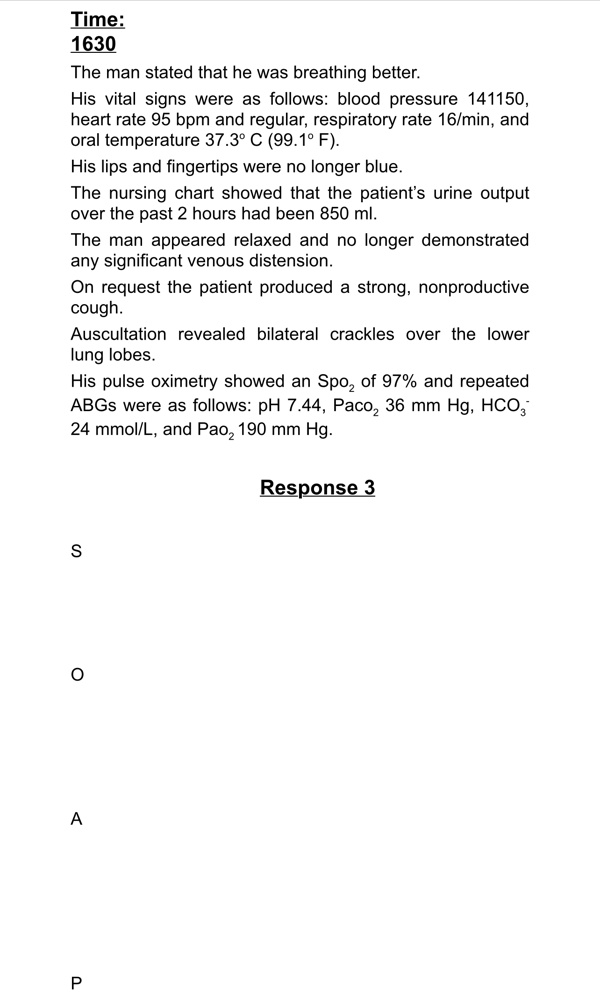
Time: 1630 The man stated that he was breathing better. His vital signs were as follows: blood pressure 141150 heart rate 95 bpm and regular,respiratory rate 16/min,and oral temperature 37.3C (99.1 F). His lips and fingertips were no longer blue. The nursing chart showed that the patient's urine output over the past 2 hours had been 850 ml. The man appeared relaxed and no longer demonstrated any significant venous distension. On request the patient produced a strong, nonproductive cough. Auscultation revealed bilateral crackles over the lower lung lobes. His pulse oximetry showed an Spo, of 97% and repeated ABGs were as follows: pH 7.44,Paco 36 mm Hg, HCO3 24 mmol/L, and Pao, 190 mm Hg.
Response 3
s
0
A
P