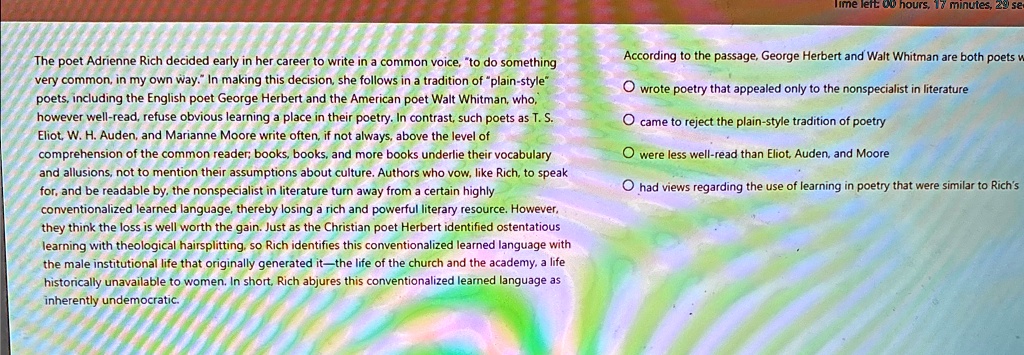
The poet Adrienne Rich decided early in her career to write in a common voice, "to do something very common, in my own way." In making this decision, she follows in a tradition of "plain-style" poets, including the English poet George Herbert and the American poet Walt Whitman, who, however well-read, refuse obvious learning a place in their poetry. In contrast, such poets as T. S. Eliot, W. H. Auden, and Marianne Moore write often, if not always, above the level of comprehension of the common reader; books, books, and more books underlie their vocabulary and allusions, not to mention their assumptions about culture. Authors who vow, like Rich, to speak for, and be readable by, the nonspecialist in literature turn away from a certain highly conventionalized learned language, thereby losing a rich and powerful literary resource. However, they think the loss is well worth the gain. Just as the Christian poet Herbert identified ostentatious learning with theological hairsplitting, so Rich identifies this conventionalized learned language with the male institutional life that originally generated it—the life of the church and the academy, a life historically unavailable to women. In short, Rich abjures this conventionalized learned language as inherently undemocratic.
According to the passage, George Herbert and Walt Whitman are both poets who wrote poetry that appealed only to the nonspecialist in literature, came to reject the plain-style tradition of poetry, were less well-read than Eliot, Auden, and Moore, and had views regarding the use of learning in poetry that were similar to Rich's.