The mapping \( (\mathrm{x}, \mathrm{y}) \rightarrow\left(\frac{1}{\mathrm{~b}} \mathrm{x}+h, a y+k\right) \) can transform \( y=f(x) \) into \( y=2+7 f\left(\frac{1}{2}(x+3)\right) \).
What would be the mapping notation of the equation?
a. \( (x, y) \rightarrow(2 x-3,7 y-2) \)
b. \( (x, y) \rightarrow\left(\frac{1}{2} x+3,7 y+2\right) \)
c. \( (x, y) \rightarrow(2 x+3,7 y+2) \)
d. \( (x, y) \rightarrow\left(\frac{1}{2} x-3,7 y-2\right) \)
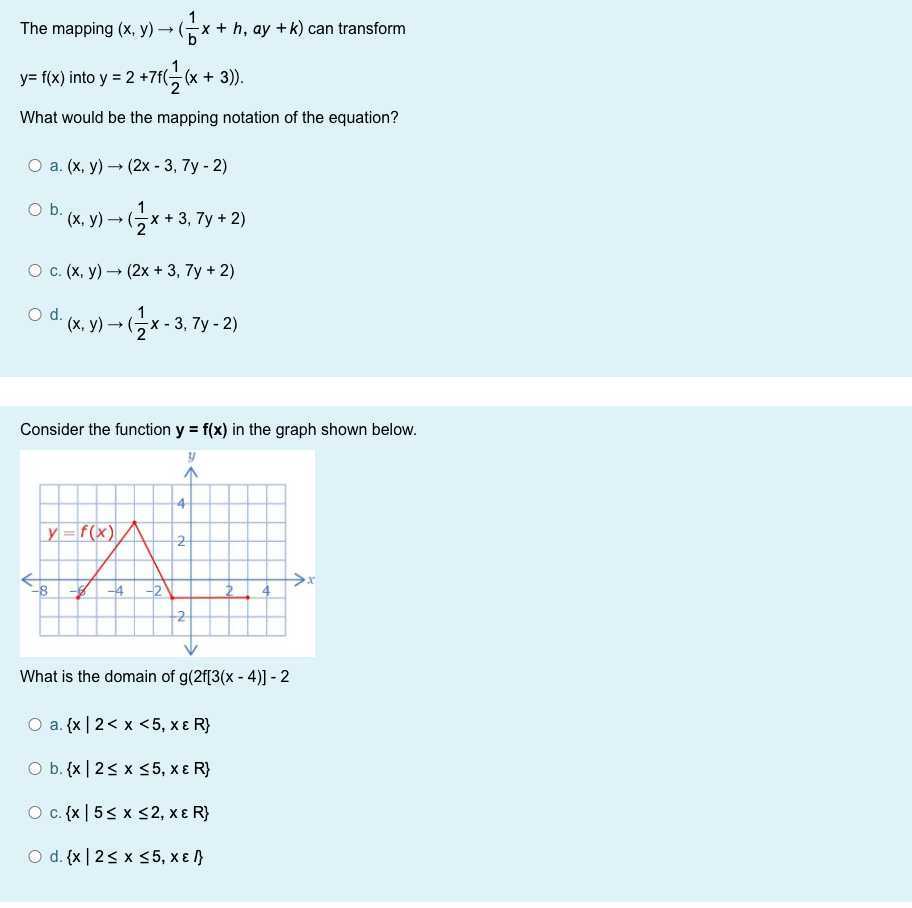
Consider the function \( \mathbf{y}=\mathbf{f}(\mathbf{x}) \) in the graph shown below.
What is the domain of \( g(2 f[3(x-4)]-2 \)
a. \( \{x \mid 2<x<5, x \in R\} \)
b. \( \{x \mid 2 \leq x \leq 5, x \in R\} \)
c. \( \{x \mid 5 \leq x \leq 2, x \varepsilon R\} \)
d. \( \{x \mid 2 \leq x \leq 5, x \in /\} \)