Ace - AI Tutor
Ask Our Educators
Textbooks
My Library
Flashcards
Scribe - AI Notes
Notes & Exams
Download App
susan hines

susan h.

Divider

Questions asked

BEST MATCH

Three consecutive odd integers can be represented in the form x, _____, and _____ not possible $$x+1, x+3$$ $$x+1, x+2$$ $$x+2, x+4$$

View Answer
divider
BEST MATCH

The pH of the equivalent point of the titration of a weak acid and strong base is 8.04. The pH increases deeply from 6.3 to 9.5 over small interval which indicator would be best for overseeing the end point of this.

View Answer
divider
BEST MATCH

The early research studies in social psychology used the scientific method to test hypotheses. Group of answer choice Tru or False

View Answer
divider
BEST MATCH

What is the role of vitamin C in bone growth? ? It stimulates osteoblast activity. ? It is necessary for the absorption of calcium by the digestive system. ? It promotes proliferation of cartilage at the epiphyseal plates. ? It promotes the cross-linking of collagen molecules in bone. ? It promotes synthesis of the glycosaminoglycans (GAGs) of the bone matrix.

View Answer
divider
BEST MATCH

In his theory of ____ Darwin proposed the attributes that are most adaptive become more prevalent in the population Structuralism nativism natural selection or functionalism

View Answer
divider
BEST MATCH

The Industrial Revolution caused the disappearance of many traditional dances from Europe. True False

View Answer
divider
BEST MATCH

Select all of the following that you need to have a typical computer system. Group of answer choices Monitor Computer Unit Stylus Keyboard & Mouse Operating System Speakers

View Answer
divider
BEST MATCH

When encrypting a message, the sender generates a random bit string called, ________? Question 17 options: Random Key Generator Initialization Vector XOR Chain Block Initiation

View Answer
divider
BEST MATCH

13. Compute $\mathcal{L}[t(1 - u_1(t)) + t^2 u_1(t)]$.

View Answer
divider
BEST MATCH

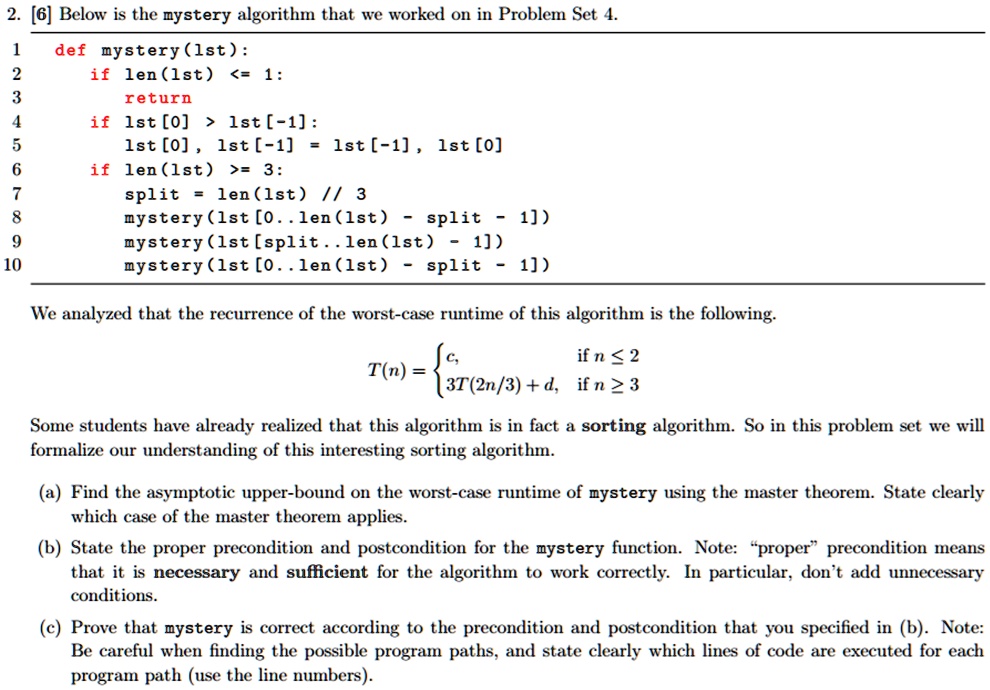
2. [6] Below is the mystery algorithm that we worked on in Problem Set 4. 1 def mystery(lst): 2 if len(lst) <= 1: 3 return 4 if lst[0] > lst[-1]: 5 lst[0], lst[-1] = lst[-1], lst[0] 6 if len(lst) >= 3: 7 split = len(lst) // 3 8 mystery(lst[0..len(lst) - split - 1]) 9 mystery(lst[split..len(lst) - 1]) 10 mystery(lst[0..len(lst) - split - 1]) We analyzed that the recurrence of the worst-case runtime of this algorithm is the following. $T(n) = \begin{cases} c, & \text{if } n \le 2\\ 3T(2n/3) + d, & \text{if } n \ge 3 \end{cases}$ Some students have already realized that this algorithm is in fact a sorting algorithm. So in this problem set we will formalize our understanding of this interesting sorting algorithm. (a) Find the asymptotic upper-bound on the worst-case runtime of mystery using the master theorem. State clearly which case of the master theorem applies. (b) State the proper precondition and postcondition for the mystery function. Note: "proper" precondition means that it is necessary and sufficient for the algorithm to work correctly. In particular, don't add unnecessary conditions. (c) Prove that mystery is correct according to the precondition and postcondition that you specified in (b). Note: Be careful when finding the possible program paths, and state clearly which lines of code are executed for each program path (use the line numbers).
View Answer
divider