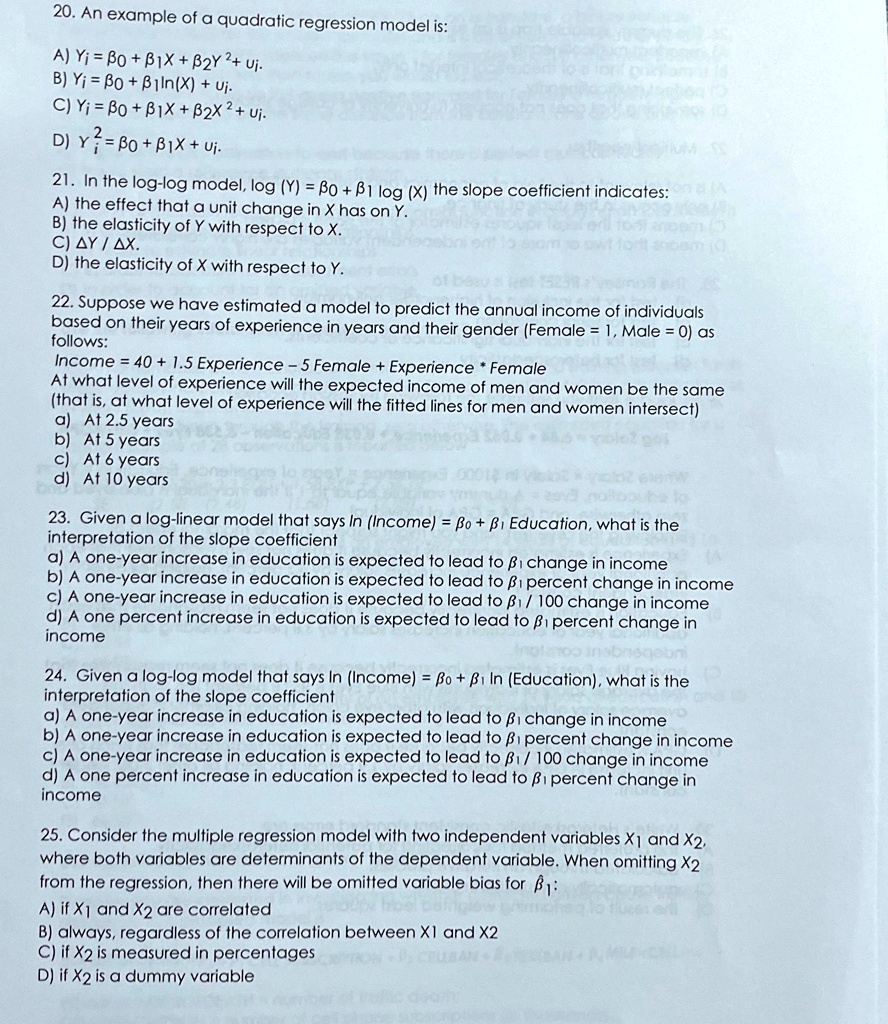
An example of a quadratic regression model is:
A) Y_(i)=�eta _(0)+�eta _(1)x+�eta _(2)Y^(2)+U_(i).
B) Y_(i)=�eta _(0)+�eta _(1)ln(x)+u_(i).
C) Y_(i)=�eta _(0)+�eta _(1)x+�eta _(2)x^(2)+u_(i).
D) Y_(i)^(2)=�eta _(0)+�eta _(1)x+u_(i).
In the log-log model, log(Y)=�eta 0+�eta 1log(x) the slope coefficient indicates:
A) the effect that a unit change in x has on Y.
B) the elasticity of Y with respect to x.
C) Delta (Y)/(Delta )x.
D) the elasticity of x with respect to Y.
Suppose we have estimated a model to predict the annual income of individuals based on their years of experience in years and their gender (Female =1, Male =0 ) as follows:
Income =40+1.5 Experience -5 Female + Experience ** Female
At what level of experience will the expected income of men and women be the same (that is, at what level of experience will the fitted lines for men and women intersect)
a) At 2.5 years
b) At 5 years
c) At 6 years
d) At 10 years
23. Given a log-linear model that says In (Income) =�eta _(0)+�eta _(1) Education, what is the interpretation of the slope coefficient
a) A one-year increase in education is expected to lead to �eta _(1) change in income
b) A one-year increase in education is expected to lead to �eta _(1) percent change in income
c) A one-year increase in education is expected to lead to (�eta _(1))/(100) change in income
d) A one percent increase in education is expected to lead to �eta _(1) percent change in income
24. Given a log-log model that says In (Income) =�eta _(0)+�eta _(1) In (Education), what is the interpretation of the slope coefficient
a) A one-year increase in education is expected to lead to �eta _(1) change in income
b) A one-year increase in education is expected to lead to �eta _(1) percent change in income
c) A one-year increase in education is expected to lead to (�eta _(1))/(100) change in income
d) A one percent increase in education is expected to lead to �eta _(1) percent change in income
25. Consider the multiple regression model with two independent variables x_(1) and x_(2), where both variables are determinants of the dependent variable. When omitting x_(2) from the regression, then there will be omitted variable bias for hat(�eta )_(1) :
A) if x_(1) and x_(2) are correlated
B) always, regardless of the correlation between x1 and x2
C) if x_(2) is measured in percentages
D) if x_(2) is a dummy variable
20.An example of a quadratic regression model is: AYi=O+X+2Y+Ui BYi=o+1InX+Ui CYi=0+X+2X+ui D)Y=O+1X+Uj
A the effect that a unit change in X has on Y B) the elasticity of Y with respect to X. CY/X. D the elasticity of X with respect to Y
22. Suppose we have estimated a model to predict the annual income of individuals based on their years of experience in years and their gender (Female = 1, Male = 0) as follows: Income=40+1.5Experience-5Female+Experience*Female At what level of experience will the expected income of men and women be the same (that is,at what level of experience will the fitted lines for men and women intersect) a)At 2.5years b)At5years cAt6years dAt 10 years
23.Given a log-linear model that says In(Income)=o+Education,what is the interpretation of the slope coefficient
b)A one-year increase in education is expected to lead to percent change in income cA one-year increase in education is expected to lead to /100 change in income d) A one percent increase in education is expected to lead to percent change in income
24. Given a log-log model that says In (Income) = o + In (Education), what is the interpretation of the slope coefficient a) A one-year increase in education is expected to lead to i change in income b) A one-year increase in education is expected to lead to percent change in income
income
25. Consider the multiple regression model with two independent variables X1 and X2, where both variables are determinants of the dependent variable. When omitting X2 from the regression, then there will be omitted variable bias for : A if XandX2are correlated B) always,regardless of the correlation between X1 and X2 C) if X2 is measured in percentages D)if X2is a dummy variable