Ace - AI Tutor
Ask Our Educators
Textbooks
My Library
Flashcards
Scribe - AI Notes
Notes & Exams
Download App
susan parker

susan p.

Divider

Questions asked

BEST MATCH

A particular fruit's weights are normally distributed, with a mean of 617 grams and a standard deviation of 15 grams. The heaviest 14% of fruits weigh more than how many grams? Give your answer to the nearest gram.

View Answer
divider
BEST MATCH

The thylakoid membrane becomes damaged, causing the inside of the thylakoid to mix with the stroma. Which of the following processes is likely to be most affected by this damage? a. The enzymes involved in the Calvin Cycle to bind to substrates in the dark. b. The water oxidation to evolve dioxygen at oxygen-evolving center in Photosystem II. c. Absorption of light energy by chlorophyll in Photosystem I. d. The reduction of NADP+ to NADPH. e. Flow of electrons from Photosystem II to Photosystem I will be disrupted. f. Carbohydrates production by the Calvin Cycle.

View Answer
divider
BEST MATCH

Alcohols generally do substitution reactions with __________________. (select all that apply) poor nucleophiles weakly basic nucleophiles strongly basic nucleophiles nucleophilic acids non-nucleophilic acids none of these

View Answer
divider
BEST MATCH

Why is a relatively large percentage of blood (in excess of need) sometimes directed to the skin? a. to produce vitamin D b. to cleanse the blood c. to eliminate wastes d. to eliminate heat e. to pick up nutrients

View Answer
divider
BEST MATCH

Complete the following statements to describe an agent of evolutionary change within a population. 1. An example of genetic drift, in which a small group of individuals establishes a larger population, is called the (Click to select). 2. A population exhibiting this effect is normally (Click to select) the general population. 3. In the founding individuals of the population, (Click to select) alleles can be present. 4. These (Click to select) alleles may be at a(n) (Click to select) frequency in the founder population than they were in the original population. 5. Because of this, evolution is said to have occurred because the (Click to select) of the population has changed.

View Answer
divider
BEST MATCH

If a price ceiling is a binding constraint on the market, the quantity supplied of the good will be greater than the quantity demanded. True False

View Answer
divider
BEST MATCH

Imagine that you have a client with Insomnia. What could an effective treatment for them? Question 7Answer a. CBT focused on the worries, unhelpful beliefs, and misconceptions about sleep b. Stimulus control to control the conditions around the person and their preparation for sleep c. Biological treatments, such as antidepressants and melatonin d. All of the above

View Answer
divider
BEST MATCH

Concentration-Time Graph [NO2] [NO] O2 2. For the graph above solve following problems a) Define reactants and products R- P- b) Find the average rate of reaction for Oxygen at first 150 s. c) Find the average rate of reaction for Nitrogen Oxide from 100 to 300 s

View Answer
divider
BEST MATCH

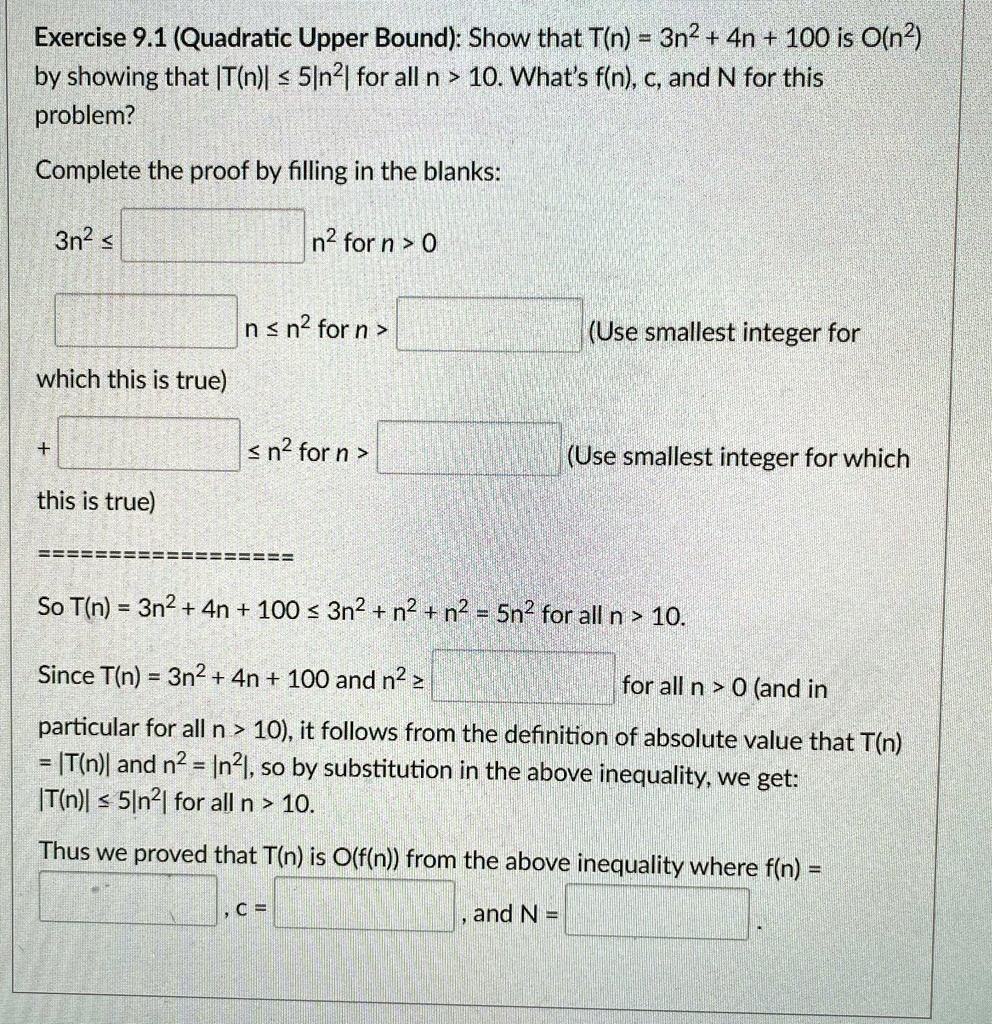
Hello, I need help with this. Thank you. Exercise 9.1 Quadratic Upper Bound: Show that Tn = 3n^2 + 4n + 100 is O(n) by showing that T(n) ≤ 5n for all n > 10. What's f(n), c, and N for this problem? Complete the proof by filling in the blanks: 3n^2 ≤ n^2 for n > 0 n^2 ≤ nforn > (Use smallest integer for which this is true) nforn > (Use smallest integer for which this is true) So, Tn = 3n^2 + 4n + 100 ≤ 3n^2 + n^2 + n^2 = 5n^2 for all n > 10. Since T(n) = 3n^2 + 4n + 100 and n^2 ≤ nforn > 0 (and in particular for all n > 10), it follows from the definition of absolute value that T(n) = |Tn and n = nl, so by substitution in the above inequality, we get: |Tn| ≤ 5n for all n > 10. Thus, we proved that T(n) is O(f(n)) from the above inequality where f(n) is n, c, and N.
View Answer
divider
BEST MATCH

Multiple Choice Question Identify a true statement about bones. O New bone is formed by osteoclasts. O Old bone is resorbed by osteoblasts. Bones continue to grow in diameter throughout life. O Bones continue to grow longitudinally until age 30.

View Answer
divider