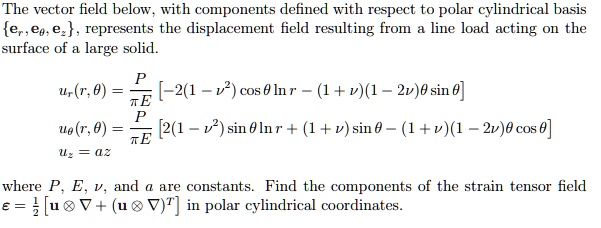
The vector field below, with components defined with respect to polar cylindrical basis \{e_r, e_\theta, e_z\}, represents the displacement field resulting from a line load acting on the surface of a large solid.\
$u_r(r, \theta) = \frac{P}{\pi E} \left[ -2(1 - \nu^2) \cos\theta \ln r - (1 + \nu)(1 - 2\nu)\theta \sin\theta \right]$
$u_\theta(r, \theta) = \frac{P}{\pi E} \left[ 2(1 - \nu^2) \sin\theta \ln r + (1 + \nu) \sin\theta - (1 + \nu)(1 - 2\nu)\theta \cos\theta \right]$
$u_z = az$
where $P$, $E$, $\nu$, and $a$ are constants. Find the components of the strain tensor field $\epsilon = \frac{1}{2} \left[ \mathbf{u} \otimes \nabla + (\mathbf{u} \otimes \nabla)^T \right]$ in polar cylindrical coordinates.