a. pK_(a2)
b. pH=6.93, [H^(+)] = 1.17 x 10^(-7) M
c. [HPO_(4)^(2-)] = 4.55 x 10^2 mmol/(d)L
d. [H_(2)PO_(4)^(-)] = 2.87 x 10^3 mmol/(d)L
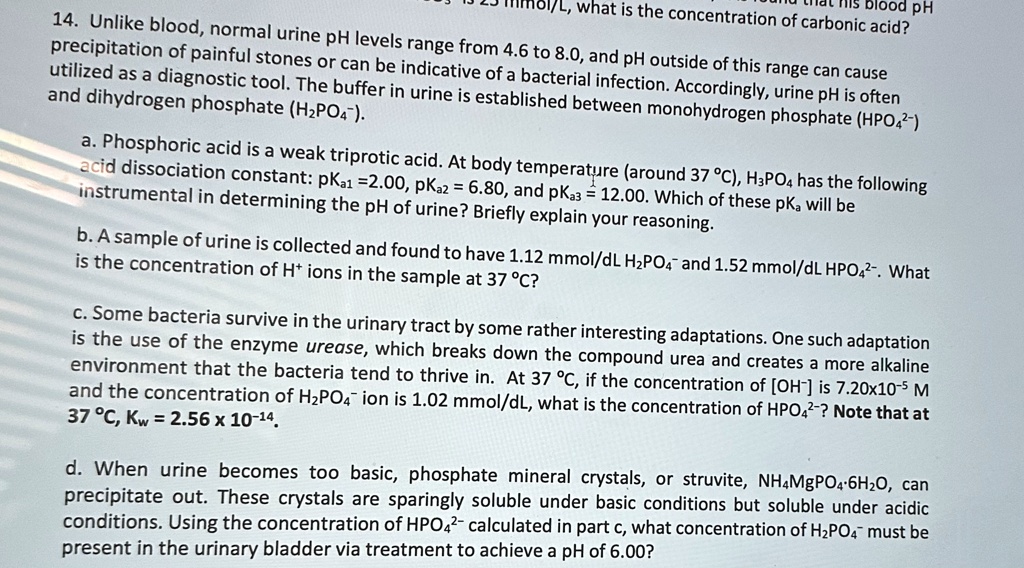
Precipitation of painful stones can range from 4.6 to 8.0, and pH outside of this range can cause issues. Urine pH is often utilized as a diagnostic tool for bacterial infections. The buffer in urine is established between monohydrogen phosphate (HPO_(4)^(2-)) and dihydrogen phosphate (H_(2)PO_(4)^(-)).
a. Phosphoric acid is a weak triprotic acid. At body temperature (around 37°C), H_(3)PO_(4) has the following acid dissociation constants: pK_(a1) = 2.00, pK_(a2) = 6.80, and pK_(a3) = 12.00. Which of these pK_(a) values will be instrumental in determining the pH of urine? Briefly explain your reasoning.
b. A sample of urine is collected and found to have 1.12 mmol/dL H_(2)PO_(4)^(-) and 1.52 mmol/dL HPO_(4)^(2-). What is the concentration of H^(+) ions in the sample at 37°C?
c. Some bacteria survive in the urinary tract by interesting adaptations. One such adaptation is the use of the enzyme urease, which breaks down urea and creates a more alkaline environment for bacteria to thrive in. At 37°C, if the concentration of OH^(-) is 7.20 x 10^(-5) M and the concentration of H_(2)PO_(4)^(-) ion is 1.02 mmol/dL, what is the concentration of HPO_(4)^(2-)? Note that at 37°C, K_(w) = 2.56 x 10^(-14).
d. When urine becomes too basic, phosphate mineral crystals, or struvite (NH_(4)MgPO_(4)*6H_(2)O), can precipitate out. These crystals are sparingly soluble under basic conditions but soluble under acidic conditions. Using the concentration of HPO_(4)^(2-) calculated in part c, what concentration of H_(2)PO_(4)^(-) must be present in the urinary bladder via treatment to achieve a pH of 6.00?