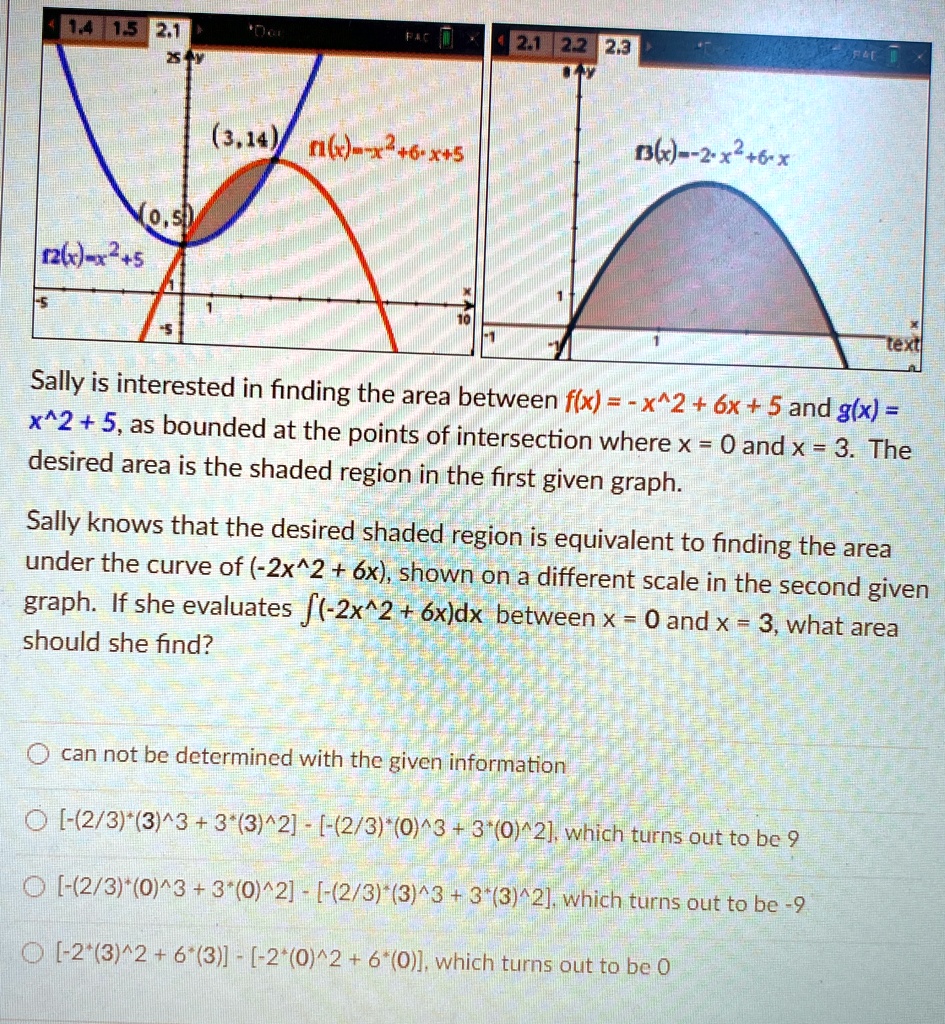
Sally is interested in finding the area between f(x)=-x^(2)+6x+5 and g(x)= x^(2)+5, as bounded at the points of intersection where x=0 and x=3. The desired area is the shaded region in the first given graph.
Sally knows that the desired shaded region is equivalent to finding the area under the curve of (-2x^(2)+6x), shown on a different scale in the second given graph. If she evaluates int (-2x^(2)+6x)dx between x=0 and x=3, what area should she find?
◻ can not be determined with the given information
[-((2)/(3))^(**)(3)^(3)+3^(**)(3)^(2)]-[-((2)/(3))^(**)(0)^(3)+3^(**)(0)^(2)], which turns out to be 9
[-((2)/(3))^(**)(0)^(3)+3^(**)(0)^(2)]-[-((2)/(3))^(**)(3)^(3)+3^(**)(3)^(2)], which turns out to be -9
◻ [-2^(**)(3)^(2)+6^(**)(3)]-[-2^(**)(0)^(2)+6^(**)(0)], which turns out to be 0
2.1
2.12.2 2.3
(3,14/16-x2+6-x+5
13x--2-x2+6-x
(0.5 12x-x2+5
Sally is interested in finding the area between fx=-x^2+6x+5andgx)= x^2+5,as bounded at the points of intersection wherex=0andx-3.The desired area is the shaded region in the first given graph. Sally knows that the desired shaded region is eguivalent to finding the area under the curve of-2x^2+6xshown on a different scale in the second given graph.If she evaluates-2x^2+6x)dx betweenx=0andx-3,what area should she find?
@ can not be determined with the given information
[-2/3*3^3+3*3^2]-[-2/3*0^3+30)^2].which turns out to be9 [-2/3*0^3+3*0^2]-[-2/3*3^3+3*32].which turns out to be-9
[-232+63]-[-20^2+6*0].which turnsout tobe 0