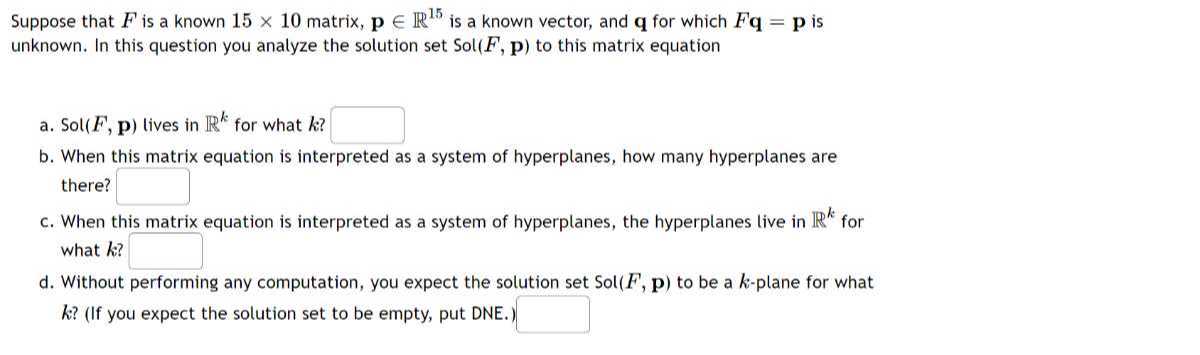
Suppose that \( F \) is a known \( 15 \times 10 \) matrix, \( \mathbf{p} \in \mathbb{R}^{15} \) is a known vector, and \( \mathbf{q} \) for which \( F \mathbf{q}=\mathbf{p} \) is unknown. In this question you analyze the solution set \( \operatorname{Sol}(F, \mathbf{p}) \) to this matrix equation
a. Sol \( (F, \mathbf{p}) \) lives in \( \mathbb{R}^{k} \) for what \( k \) ? \( \square \)
b. When this matrix equation is interpreted as a system of hyperplanes, how many hyperplanes are there? \( \square \)
c. When this matrix equation is interpreted as a system of hyperplanes, the hyperplanes live in \( \mathbb{R}^{k} \) for what \( k \) ? \( \square \)
d. Without performing any computation, you expect the solution set \( \operatorname{Sol}(F, \mathbf{p}) \) to be a \( k \)-plane for what \( k \) ? (If you expect the solution set to be empty, put DNE.) \( \square \)