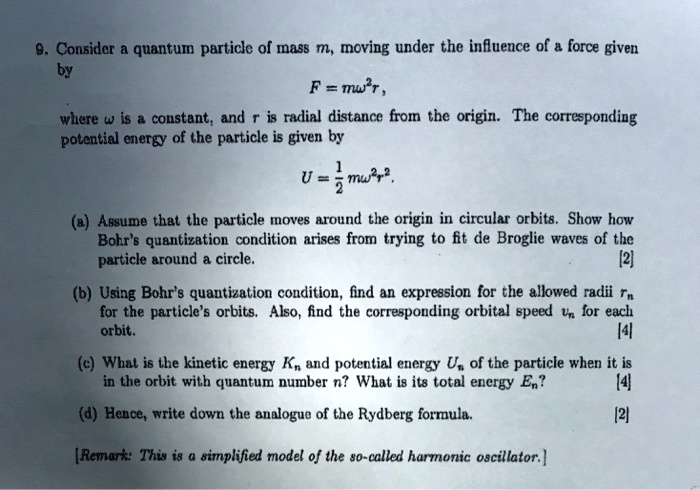
9. Consider a quantum particle of mass $m$, moving under the influence of a force given
by
$F = m\omega^3 r$,
where $\omega$ is a constant, and $r$ is radial distance from the origin. The corresponding
potential energy of the particle is given by
$U = \frac{1}{2} m\omega^2 r^2$.
(a) Assume that the particle moves around the origin in circular orbits. Show how
Bohr's quantization condition arises from trying to fit de Broglie waves of the
particle around a circle.
[2]
(b) Using Bohr's quantization condition, find an expression for the allowed radii $r_n$
for the particle's orbits. Also, find the corresponding orbital speed $v_n$ for each
orbit.
[4]
(c) What is the kinetic energy $K_n$, and potential energy $U_n$ of the particle when it is
in the orbit with quantum number $n$? What is its total energy $E_n$?
[4]
(d) Hence, write down the analogue of the Rydberg formula.
[2]
[Remark: This is a simplified model of the so-called harmonic oscillator.]