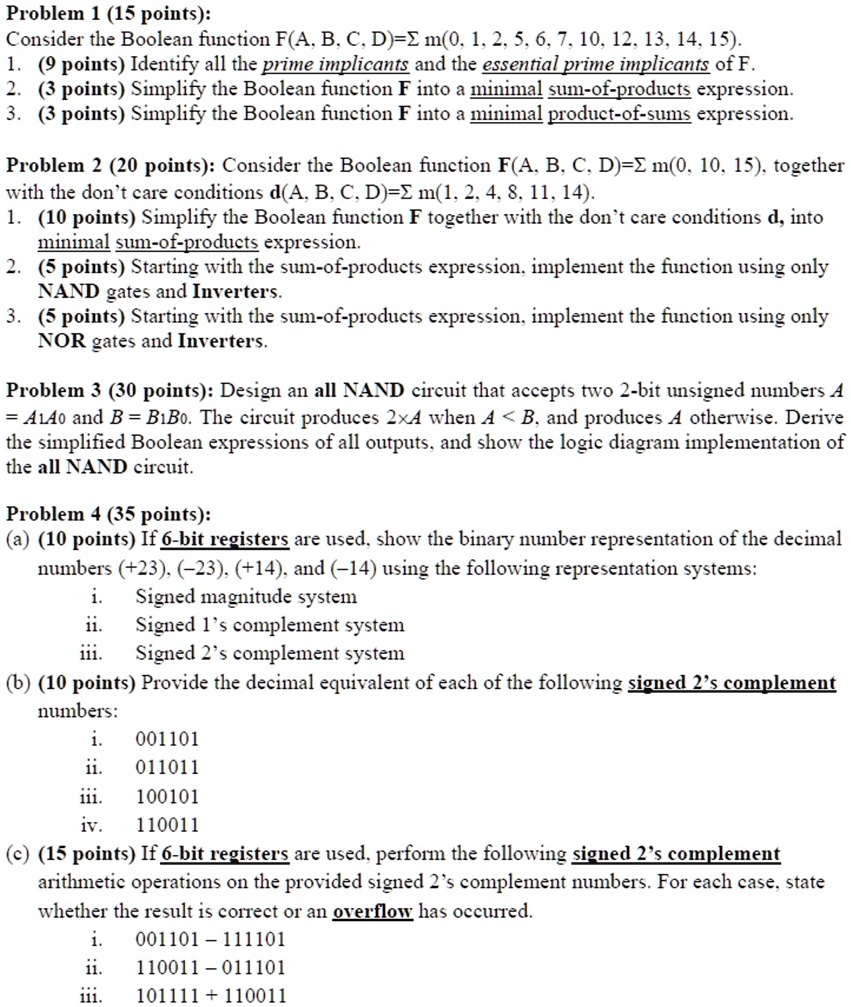
Problem 1 (15 points): Consider the Boolean function F(A, B, C, D) = E m(0, 1, 2, 5, 6, 7, 10, 12, 13, 14, 15)
1. (9 points) Identify all the prime implicants and the essential prime implicants of F.
2. (3 points) Simplify the Boolean function F into a minimal sum-of-products expression.
3. (3 points) Simplify the Boolean function F into a minimal product-of-sums expression.
Problem 2 (20 points): Consider the Boolean function F(A, B, C, D) = m(0, 10, 15), together with the don't care conditions d(A, B, C, D) = E m(1, 2, 4, 8, 11, 14)
1. (10 points) Simplify the Boolean function F together with the don't care conditions d, into minimal sum-of-products expression.
2. (5 points) Starting with the sum-of-products expression, implement the function using only NAND gates and Inverters.
3. (5 points) Starting with the sum-of-products expression, implement the function using only NOR gates and Inverters.
Problem 3 (30 points): Design an all NAND circuit that accepts two 2-bit unsigned numbers A = AiAo and B = BiBo. The circuit produces 2A when A < B, and produces A otherwise. Derive the simplified Boolean expressions of all outputs, and show the logic diagram implementation of the all NAND circuit.
Problem 4 (35 points):
(a) (10 points) If 6-bit registers are used, show the binary number representation of the decimal numbers (+23), (-23), (+14), and (-14) using the following representation systems:
i. Signed magnitude system
ii. Signed 1's complement system
iii. Signed 2's complement system
(b) (10 points) Provide the decimal equivalent of each of the following signed 2's complement numbers:
i. 001101
ii. 011011
iii. 100101
iv. 110011
(c) (15 points) If 6-bit registers are used, perform the following signed 2's complement arithmetic operations on the provided signed 2's complement numbers. For each case, state whether the result is correct or an overflow has occurred:
i. 001101 - 111101
ii. 110011 - 011101
iii. 101111 + 110011