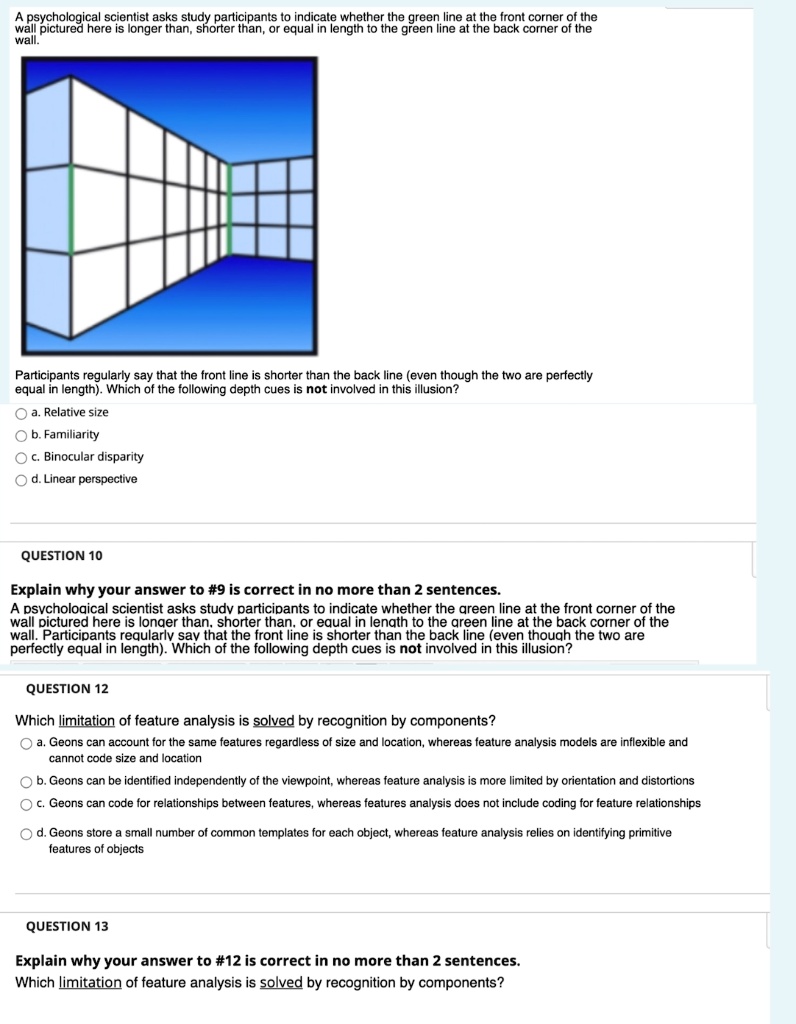
A psychological scientist asks study participants to indicate whether the green line at the front corner of the
wall pictured here is longer than, shorter than, or equal in length to the green line at the back corner of the
wall.
Participants regularly say that the front line is shorter than the back line (even though the two are perfectly
equal in length). Which of the following depth cues is not involved in this illusion?
a. Relative size
b. Familiarity
c. Binocular disparity
d. Linear perspective
QUESTION 10
Explain why your answer to #9 is correct in no more than 2 sentences.
A psychological scientist asks study participants to indicate whether the green line at the front corner of the
wall pictured here is longer than, shorter than, or equal in length to the green line at the back corner of the
wall. Participants regularly say that the front line is shorter than the back line (even though the two are
perfectly equal in length). Which of the following depth cues is not involved in this illusion?
QUESTION 12
Which limitation of feature analysis is solved by recognition by components?
a. Geons can account for the same features regardless of size and location, whereas feature analysis models are inflexible and
cannot code size and location
b. Geons can be identified independently of the viewpoint, whereas feature analysis is more limited by orientation and distortions
c. Geons can code for relationships between features, whereas features analysis does not include coding for feature relationships
d. Geons store a small number of common templates for each object, whereas feature analysis relies on identifying primitive
features of objects
QUESTION 13
Explain why your answer to #12 is correct in no more than 2 sentences.
Which limitation of feature analysis is solved by recognition by components?