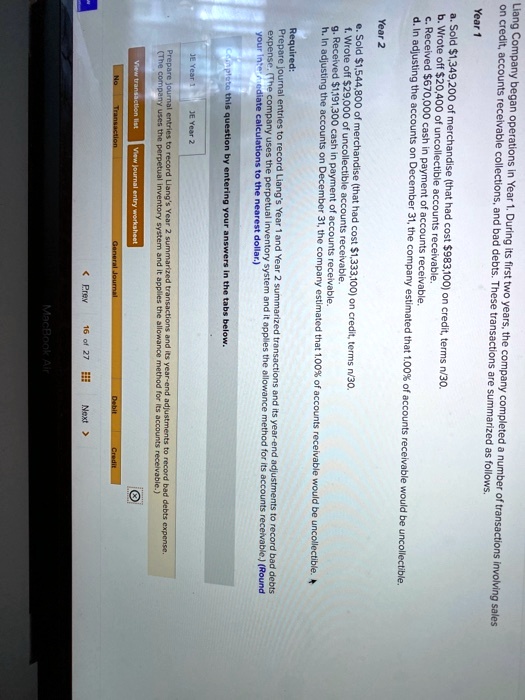
Liang Company began operations in Year 1. During its first two years, the company completed a number of transactions involving sales on credit, accounts receivable collections, and bad debts. These transactions are summarized as follows.
Year 1
a. Sold $1,349,200 of merchandise (that had cost $983,100) on credit, terms n/30.
b. Wrote off $20,400 of uncollectible accounts receivable.
c. Received $670,000 cash in payment of accounts receivable.
d. In adjusting the accounts on December 31, the company estimated that 1.00% of accounts receivable would be uncollectible.
Year 2
e. Sold $1,544,800 of merchandise (that had cost $1,333,100) on credit, terms n/30.
f. Wrote off $29,000 of uncollectible accounts receivable.
g. Received $1,191,300 cash in payment of accounts receivable.
h. In adjusting the accounts on December 31, the company estimated that 1.00% of accounts receivable would be uncollectible.
Required:
Prepare journal entries to record Liang's Year 1 and Year 2 summarized transactions and its year-end adjustments to record bad debts expense. (The company uses the perpetual inventory system and it applies the allowance method for its accounts receivable.) (Round your intermediate calculations to the nearest dollar.)
Complete this question by entering your answers in the tabs below.
JE Year 1
JE Year 2
Prepare journal entries to record Liang's Year 2 summarized transactions and its year-end adjustments to record bad debts expense. (The company uses the perpetual inventory system and it applies the allowance method for its accounts receivable.)
View transaction list
View journal entry worksheet
No
Transaction
General Journal
Debit
Credit
< Prev
16 of 27
Next >
MacBook Air