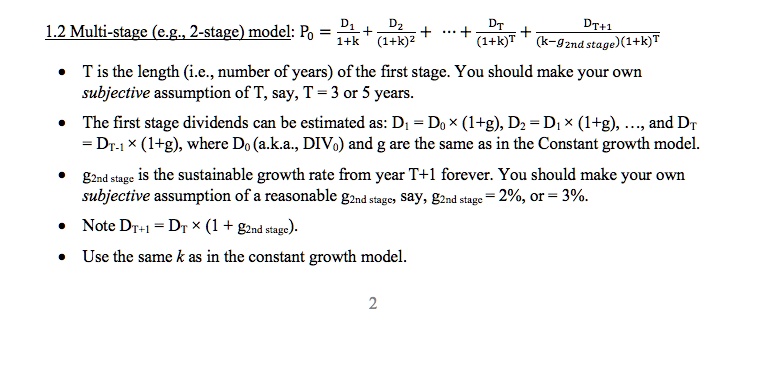
1.2 Multi-stage (e.g., 2-stage) model: $P_0 = \frac{D_1}{1+k} + \frac{D_2}{(1+k)^2} + \dots + \frac{D_T}{(1+k)^T} + \frac{D_{T+1}}{(k-g_{2nd\ stage})(1+k)^T}$
• T is the length (i.e., number of years) of the first stage. You should make your own
subjective assumption of T, say, T = 3 or 5 years.
• The first stage dividends can be estimated as: $D_1 = D_0 \times (1+g)$, $D_2 = D_1 \times (1+g)$, ..., and $D_T$
$= D_{T-1} \times (1+g)$, where $D_0$ (a.k.a., $DIV_0$) and g are the same as in the Constant growth model.
• $g_{2nd\ stage}$ is the sustainable growth rate from year T+1 forever. You should make your own
subjective assumption of a reasonable $g_{2nd\ stage}$, say, $g_{2nd\ stage} = 2\%$, or = 3%.
• Note $D_{T+1} = D_T \times (1 + g_{2nd\ stage})$.
• Use the same k as in the constant growth model.