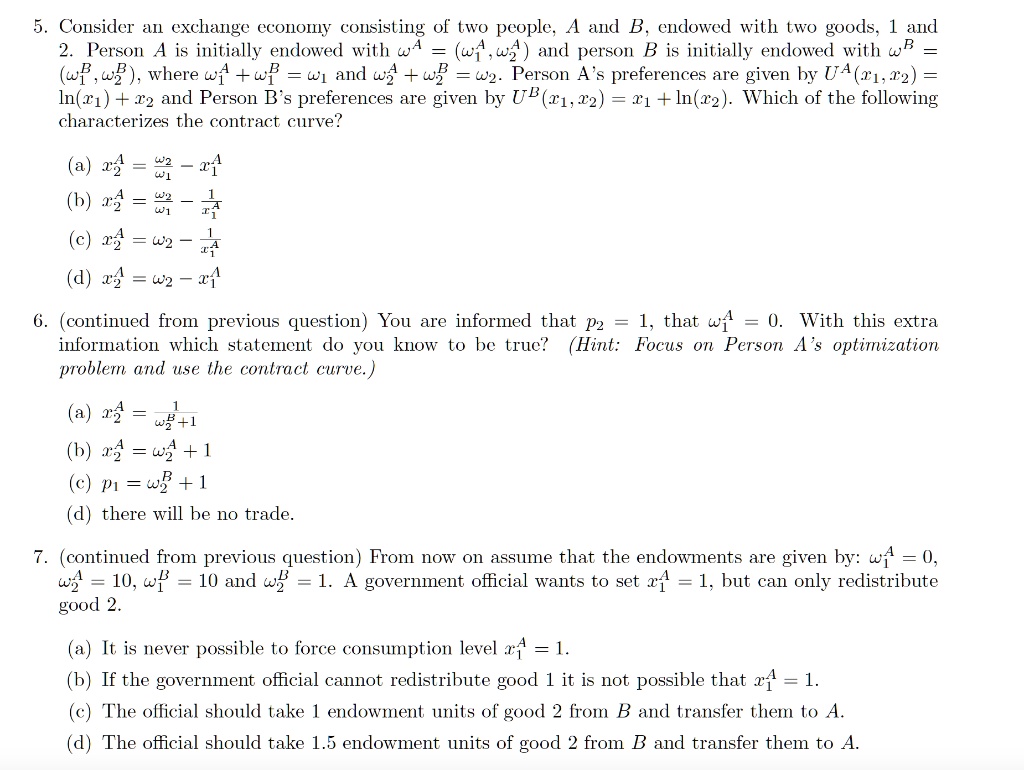
This is a single question that is multi-part. The answers are:
5. C, 6. C, 7. C, but need to understand the work needed to get to that answer.
5. Consider an exchange economy consisting of two people, A and B, endowed with two goods, 1 and 2. Person A is initially endowed with wA = (w1,w2) and person B is initially endowed with wB = (w3,w4), where w1 + w3 = wA and w2 + w4 = wB. Person A's preferences are given by UA(1,2) = ln(1) + 2 and Person B's preferences are given by UB(1,2) = x1 + ln(2). Which of the following characterizes the contract curve?
(a) x1 = w2 - x1
(b) x2 = w2 - x1
(c) x1 = wA - x1
(d) x2 = wA - x1
6. (continued from previous question) You are informed that P2 = 1, that wA = 0. With this extra information which statement do you know to be true? (Hint: Focus on Person A's optimization problem and use the contract curve.)
(a) x = w + 1
(b) x = wA + 1
(c) p1 = wB + 1
(d) there will be no trade.
7. (continued from previous question) From now on assume that the endowments are given by: wA = 0, w1 = 10, wB = 10 and w4 = 1. A government official wants to set x1 = 1, but can only redistribute good 2.
(a) It is never possible to force consumption level x1 = 1.
(b) If the government official cannot redistribute good 1, it is not possible that x1 = 1.
(c) The official should take 1 endowment unit of good 2 from B and transfer it to A.
(d) The official should take 1.5 endowment units of good 2 from B and transfer them to A.