Ace - AI Tutor
Ask Our Educators
Textbooks
My Library
Flashcards
Scribe - AI Notes
Notes & Exams
Download App
tara butler

tara b.

Divider

Questions asked

BEST MATCH

1. Which of the following proteins bind to mediator during initiation of transcription of a eukaryotic gene? [ ] RNA polymerase [ ] Specific transcription factors for the gene [ ] Activator proteins bound to enhancer sequences [ ] Transcription factor IID [ ] Transcription factor IIH [ ] Chromatin remodeling complexes

View Answer
divider
BEST MATCH

Parallel-plate capacitor with dielectric [8 pts.] A charged air-filled capacitor charged is connected to a 12 V battery. A sheet of dielectric with k=5 is inserted completely filling the volume between its plates. As a result, the electric energy stored in the capacitor is: (A) 1/25 of the original (B) 1/5 of the original (C) unchanged (D) 5 times the original (E) 9 times the original (F) 25 times the original

View Answer
divider
BEST MATCH

1. Proporcione los nombres IUPAC de los siguientes compuestos. (2 puntos cada uno) HS O-CH2-CH3 CH-CH3 a. CH3-CH2 CI H3CS b. OH F 2. Dibuje la estructura para: 1-bromo-7-metil-7-metoxioct-4-in-2-ol (2 puntos) 3. Dibuje el producto principal o escriba el reactivo necesario de las siguientes reacciones. (2 puntos cada uno) CH3 --CH2-CH 1. a. CH3-CH2-C-C-CH3 CH3 CH3 H 2. H3O+ b. H H H

View Answer
divider
BEST MATCH

Which class of drugs commonly target voltage gated sodium channels to stabilize neuronal membranes and reduce excitability?

View Answer
divider
BEST MATCH

What is the fundamental building block of an SQL statement? Select an answer: a table a clause a field a phrase

View Answer
divider
BEST MATCH

p² + 2pq + q² = 1 The short cats (tt) are represented by q² in the equation, so we can calculate the frequency of q² (tt). 16 short cats (tt) / 100 total cats = 0.16 q² = 0.16 Remember, that p + q = 1 so if we determine the frequency of q, we can then calculate the frequency of p and use those values to calculate the frequency of TT and Tt. To calculate q, we first have to determine the square root of q². ?0.16 = 0.40 = q Now we can calculate p using the equation p + q = 1 p + 0.40 = 1 p = 1 - 0.40 p = 0.60 Now we know the frequencies of the alleles. Use these frequencies to calculate p² (TT) and 2pq (Tt), showing your work in your answer. When you are done, add all three frequencies together (we already know q²)-they should equal 1. If they do not, review your calculations and correct your answer. One step that tends to trip students up is the calculation of 2pq, don't forget the 2 when multiplying.

View Answer
divider
BEST MATCH

A step down transformer has 286 windings on its primary coil and 48 windings on the secondary coil. If the voltage output is 120 V, what is the input voltage? Express your answer in volts rounded to the nearest whole.

View Answer
divider
BEST MATCH

Show the integral in which the substitution $x = \frac{4}{5}tan(t)$ transforms $I = \int \frac{dx}{\sqrt{25x^2 + 16}}$ (Use symbolic notation and fractions where needed.) $I = \int \underline{\qquad\qquad\qquad\qquad\qquad\qquad}dt$ Evaluate the integral $I$ in terms of $t$. (Use symbolic notation and fractions where needed. Use $C$ for the arbitrary constant. Absorb $C$ into $C$ as much as possible.) $I = \underline{\qquad\qquad\qquad\qquad\qquad\qquad}$ Evaluate the integral $I$ in terms of $x$. (Use symbolic notation and fractions where needed. Use $C$ for the arbitrary constant. Absorb $C$ into $C$ as much as possible.) $I = \underline{\qquad\qquad\qquad\qquad\qquad\qquad}$

View Answer
divider
BEST MATCH

3. A centrally-loaded column (cross-section shown), is a 10-in. x 49 lb, wide flange I-beam whose properties are: ky = 2.54 in. kx = 4.35 in. A = 14.14 in$^2$ Ix = 272.9 in$^4$ Iy = 93.0 in$^4$ Let Le = 0.8L L = 30 ft. Material: AISI 1022, as rolled Determine the critical load; a. According to Johnson's or Euler's equation b. According to Secant formula if ec/k$^2$ is assumed to be 0.25 Use the ff. data taken from the table: Sy = 52 ksi E = 30x10$^6$ psi

View Answer
divider
BEST MATCH

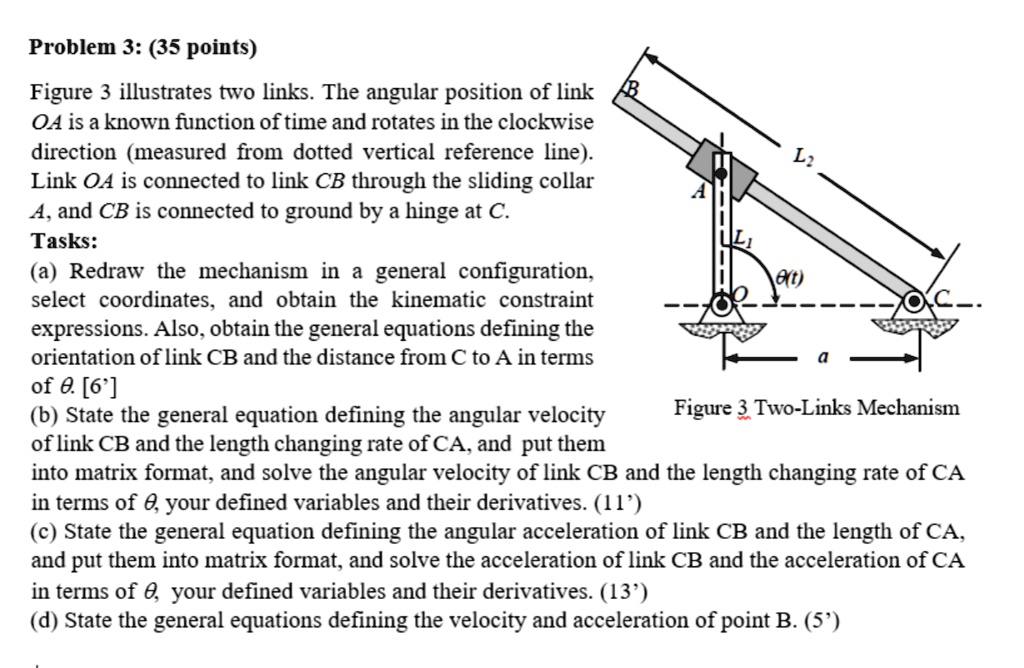
Problem 3: (35 points) Figure 3 illustrates two links. The angular position of link B OA is a known function of time and rotates in the clockwise direction (measured from dotted vertical reference line). Link OA is connected to link CB through the sliding collar A, and CB is connected to ground by a hinge at C. Tasks: (a) Redraw the mechanism in a general configuration, select coordinates, and obtain the kinematic constraint expressions. Also, obtain the general equations defining the orientation of link CB and the distance from C to A in terms of $\theta$. [6'] (b) State the general equation defining the angular velocity of link CB and the length changing rate of CA, and put them into matrix format, and solve the angular velocity of link CB and the length changing rate of CA in terms of $\theta$, your defined variables and their derivatives. (11') (c) State the general equation defining the angular acceleration of link CB and the length of CA, and put them into matrix format, and solve the acceleration of link CB and the acceleration of CA in terms of $\theta$, your defined variables and their derivatives. (13') (d) State the general equations defining the velocity and acceleration of point B. (5')
View Answer
divider