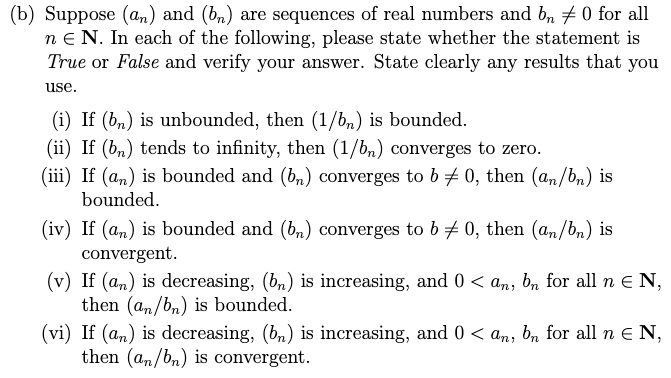
(b) Suppose ($a_n$) and ($b_n$) are sequences of real numbers and $b_n \neq 0$ for all $n \in \mathbb{N}$. In each of the following, please state whether the statement is True or False and verify your answer. State clearly any results that you use.
(i) If ($b_n$) is unbounded, then ($1/b_n$) is bounded.
(ii) If ($b_n$) tends to infinity, then ($1/b_n$) converges to zero.
(iii) If ($a_n$) is bounded and ($b_n$) converges to $b \neq 0$, then ($a_n/b_n$) is bounded.
(iv) If ($a_n$) is bounded and ($b_n$) converges to $b \neq 0$, then ($a_n/b_n$) is convergent.
(v) If ($a_n$) is decreasing, ($b_n$) is increasing, and $0 < a_n, b_n$ for all $n \in \mathbb{N}$, then ($a_n/b_n$) is bounded.
(vi) If ($a_n$) is decreasing, ($b_n$) is increasing, and $0 < a_n, b_n$ for all $n \in \mathbb{N}$, then ($a_n/b_n$) is convergent.